

Yokohama launches the BluEarth-AllSeason2
Yokohama has launched the BluEarth-AllSeason2, its second-generation European all-season tyre and successor to the BluEarth-4S AW21. We travelled to the Iceland launch to drive it, and look at Yokohama's claims of much-improved dry and wet grip ahead of independent testing.


Contents
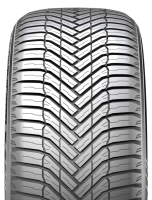
Yokohama has launched the BluEarth-AllSeason2, its second-generation all-season tyre for Europe and the direct successor to the BluEarth-4S AW21. The tyre was unveiled to media in Reykjavik, Iceland in June 2026, with a European sales launch scheduled for September 2026. Yokohama is aiming it at passenger cars, SUVs and electric vehicles, and will offer it in 74 sizes spanning 15 to 21 inches, which the company says covers roughly 80 percent of the European fitment market.
The headline of this generation, in Yokohama's own words, is a large step up in dry and wet performance, while keeping the snow and winter ability that the outgoing 4S AW21 was known for. It carries the M+S marking and the 3PMSF (three-peak mountain snowflake) severe-snow symbol.
We drove it in Iceland
Yokohama invited us out to the Iceland launch, where we drove the BluEarth-AllSeason2 on a fleet of BMW X1s across a short dry road loop and a snow / ice area on a glacier. This was very much a first taste rather than a full test: the mileage was limited, and there was no back-to-back run against rival brands, so I am not drawing any firm conclusions from it yet. With that said, it was a positive first impression.
Where it fits in the range
The BluEarth-AllSeason2 fills the all-season slot in Yokohama's revamped European line-up, sitting alongside the ADVAN Sport summer tyres and the ADVAN winter range. Yokohama is chasing a European all-season segment that has grown quickly in recent years and now accounts for a meaningful share of replacement sales in markets like Germany, France and Italy, and it positions this tyre as the year-round option for drivers who do not want to switch between summer and winter sets.
Key technical changes
According to Yokohama, the gains over the 4S AW21 come from a new tread pattern, a new compound and a revised casing, developed with a design process the company calls HAICoLab, where its engineers work alongside AI tools to optimise the tread.
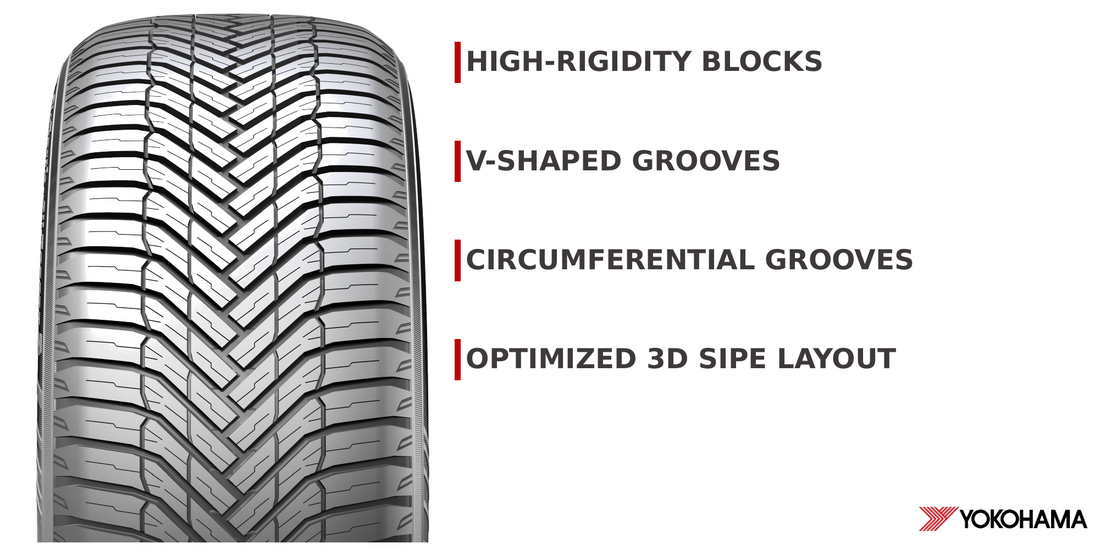
- Tread pattern: Yokohama says the centre blocks are enlarged and the groove bases reinforced for around 35 percent more block rigidity than the previous product, which it links to sharper dry handling. A directional V-shaped groove layout and continuous circumferential grooves are there to clear water, while an optimised 3D crank-sipe layout is intended to add biting edges for snow without giving up dry stability.
- Compound: The new compound uses a high silica content with a snow polymer blend, mixed using Yokohama's A.R.T. mixing technology, which the company says improves how well the silica disperses and keeps the compound flexible. Yokohama claims this raises the real contact area between the rubber and a wet road by around 40 percent versus the previous compound.
- Profile: A revised tread profile is said to increase the ground contact patch by about 5 percent for more even grip and traction.
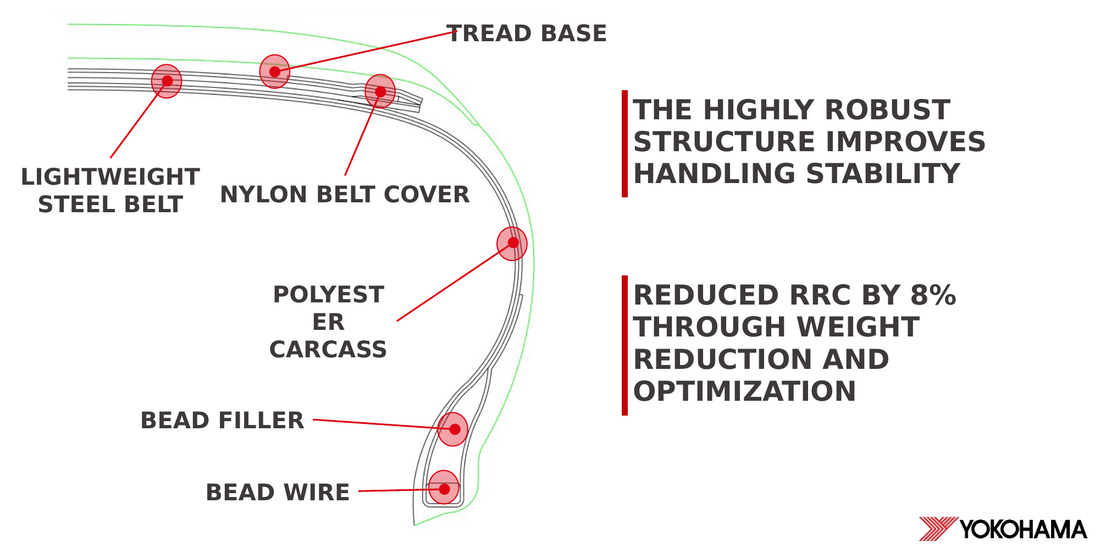
Underneath, Yokohama says a more robust casing improves handling stability, and that weight reduction and optimisation of the structure cut rolling resistance by around 8 percent, which matters for both fuel use and EV range. The winter side of the tyre leans on what Yokohama brands COLD TECH, a set of compound and contact-area measures it already uses on its dedicated winter products to keep grip up as temperatures fall.
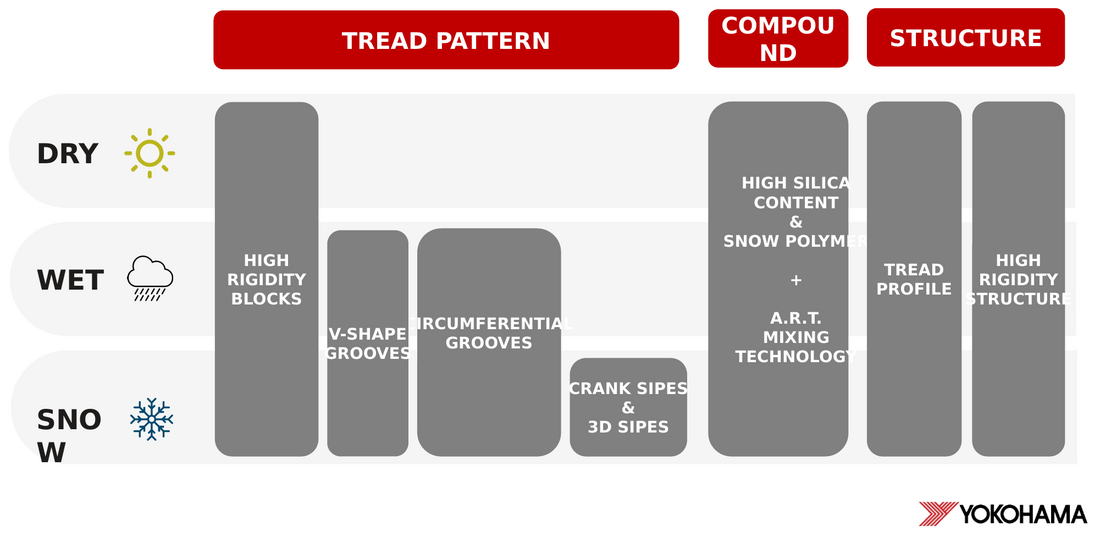
Manufacturer performance claims
The performance picture above is Yokohama's own, drawn from its internal development testing, and has not yet been independently verified. In short, Yokohama frames the BluEarth-AllSeason2 as strongly improved on dry and wet roads, with winter performance held at the same high level as the 4S AW21 and slightly improved thanks to COLD TECH. As with any launch, we would treat those descriptions as marketing until they have been checked on neutral ground.
At the launch Yokohama also showed a slide comparing the BluEarth-AllSeason2 directly against the outgoing 4S AW21, test by test. These are the company's own internal figures rather than independent results, but they set out plainly where it believes the gains are: a big lift in the dry, a solid step in the wet, and winter grip carried over rather than traded away.
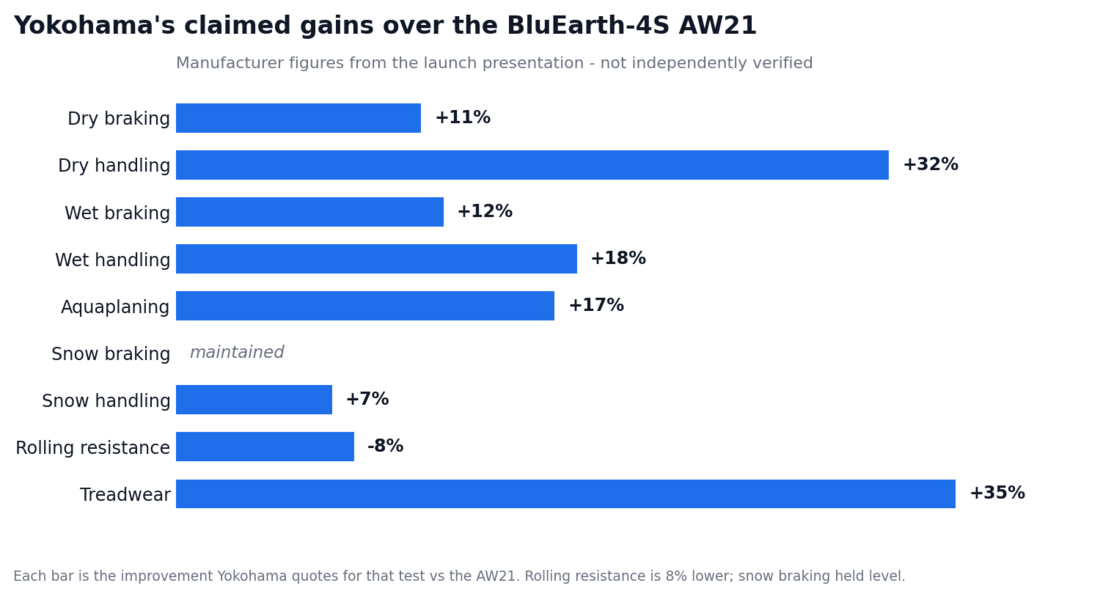
Reading Yokohama's slide against the outgoing 4S AW21:
- Dry: handling up 32 percent and braking up 11 percent, the biggest single gain in the set.
- Wet: handling up 18 percent, aquaplaning resistance up 17 percent and braking up 12 percent. That last figure matters most, because wet braking is exactly where the old tyre needed to improve.
- Snow: braking held level and handling up 7 percent, so the winter ability that made the AW21 worth buying is retained.
- Efficiency and wear: rolling resistance down 8 percent and wear resistance up 35 percent.
There is useful independent context on the tyre it replaces. The BluEarth-4S AW21 was a capable snow tyre but tended to lag the premium front-runners on dry and wet tarmac when tested independently. In our own 2024 all-season test it finished sixth of seven, behind the likes of the Continental AllSeasonContact 2 and Michelin CrossClimate 2, and it placed 14th of 16 in the 2024 ADAC all-season test. That is exactly the area, dry and wet grip, where Yokohama says it has concentrated this update.
EU label, sizes and availability
- EU label: Yokohama quotes a wet grip rating of B, rolling resistance of C to D and external noise of A to B, varying by size.
- Sizes: 74 sizes from 15 to 21 inches, covering passenger cars, SUVs and EVs.
- Availability: Unveiled in Iceland in June 2026, with European sales starting in September 2026.
What it means for drivers
On paper the BluEarth-AllSeason2 looks like a sensible, targeted update: keep the winter ability that made the 4S AW21 worth buying, and fix the dry and wet performance that held it back against premium rivals. The Iceland drive was too short and too controlled to prove any of that, but the new tyre felt a clear step on from its predecessor, which is a promising start given how much ground there was to make up. Whether the dry, wet and efficiency claims hold up is the open question, and we plan to test the BluEarth-AllSeason2 independently once tyres reach the market. We will report back with real numbers when we do. For the complete technical detail and Yokohama's own figures, see the manufacturer's launch material.

Filed under General tyre newsTyre Launches
More on General tyre news
 12 Hours of Thunderhill on One Set of Hankook Ventus RS4 TyresCan you find a 200 treadwear track tyre that will last a 12 hour race on a front-wheel drive car? It seemed like an impossible task, but on 19 Septemb...
 The BFGoodrich KO3 Phase Three is complete, and this is the full size listBFGoodrich is entering the final major stage of its All-Terrain T/A KO3 rollout, adding a dozen new sizes and bringing the line-up to 119 sizes. The a...
 Michelin CrossClimate 3: Why North America Is Being Left Out (For Now)If you’ve been watching our recent coverage from Europe, you'll know that the Michelin CrossClimate 3 and CrossClimate 3 Sport launched in Europe in J...
 Michelin Launches The Pilot Sport Endurance 2026: Racing Towards a Sustainable FutureMichelin has unveiled its next-generation racing tyres for the IMSA WeatherTech SportsCar Championship, featuring 50% renewable and recycled materials...
And the trend continues: Pirelli, Bridgestone, Michelin, and other major manufacturers are doing exactly the same. In fact, some of them no longer offer their latest tire models even in 15-inch sizes, let alone anything smaller.
Which is rather ironic, considering that this is exactly the segment that has undergone tremendous development over the past decade.