About Tyre Reviews
What is tyre.info? The Tyre Reviews Data API and Rating Widgets
tyre.info is the Tyre Reviews data service, which lets tyre retailers, garages and manufacturers show our scores, professional test results, owner reviews and EU label data on their own sites, either as widgets or through an API. This article covers what is available, how the t.i score and its confidence tiers work, the API endpoints and what it costs.
On this page
tyre.info is the Tyre Reviews data service. It lets tyre retailers, garages and manufacturers show our scores, professional test results, owner reviews and EU label data on their own websites, either as ready-made widgets or through an API.
It has been running for a while now, but we have never really written about it, so this article explains what it is, what data is available and what it costs. If you are here as a driver rather than a retailer, the short version is that this is how the data on this site gets licensed, and the income from it goes back into our testing programme.
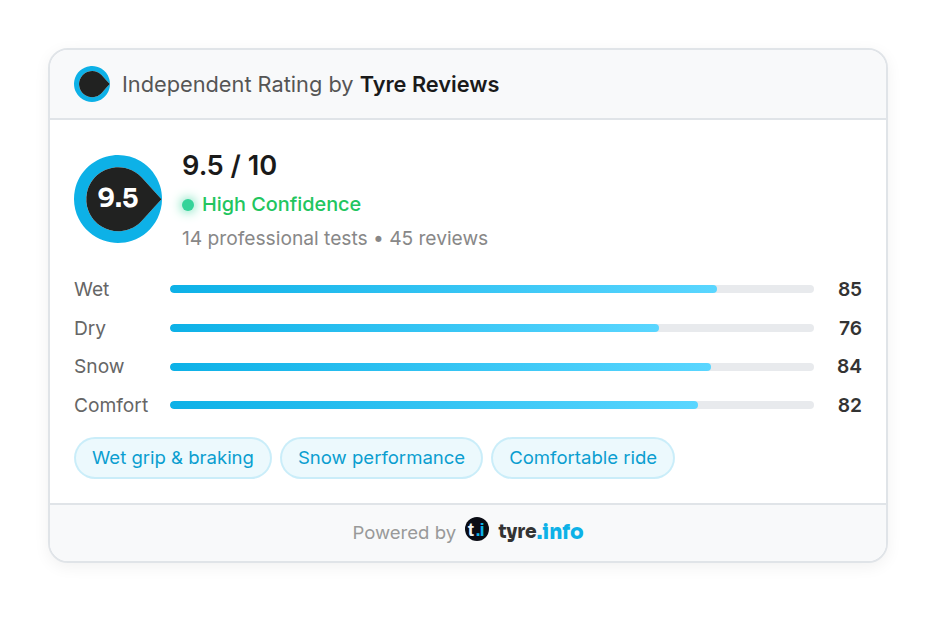
Two ways to use it
There are two ways to get the data onto a site, and most integrations use both at different stages.
Hosted components added with a single script tag. A score card, a review module, a comparison block or an inline badge appears on the page without any back-end work. They can be restyled to match the site they sit on.
A REST API at api.tyre.info returning JSON or XML, for anyone building their own interface, a counter or point of sale lookup, or an app. Authentication is by key, with domain allowlists and rate-limit headers.
The t.i score
The main number in the data is the t.i score, a 0 to 10 rating combining professional test results with owner reviews. It is the same score shown on tyre pages across this site, and how it is calculated is explained in The Tyre Reviews Score.
Two details are worth knowing if you are going to display it. The first is that scores are statistically smoothed, so a tyre with a handful of reviews is pulled toward the category average rather than jumping to the top of the table on thin evidence, and newer data counts for more than old data. The second is that every score carries a confidence tier of High, Medium or Limited, based on how many tests and reviews sit behind it. That tier is there so an interface can treat a well-evidenced tyre differently from a barely-reviewed one.
Below the headline number are seven categories: dry, wet, snow, ice, comfort, value and off-road. The scoring methodology is published and versioned, and API responses record which version produced them.
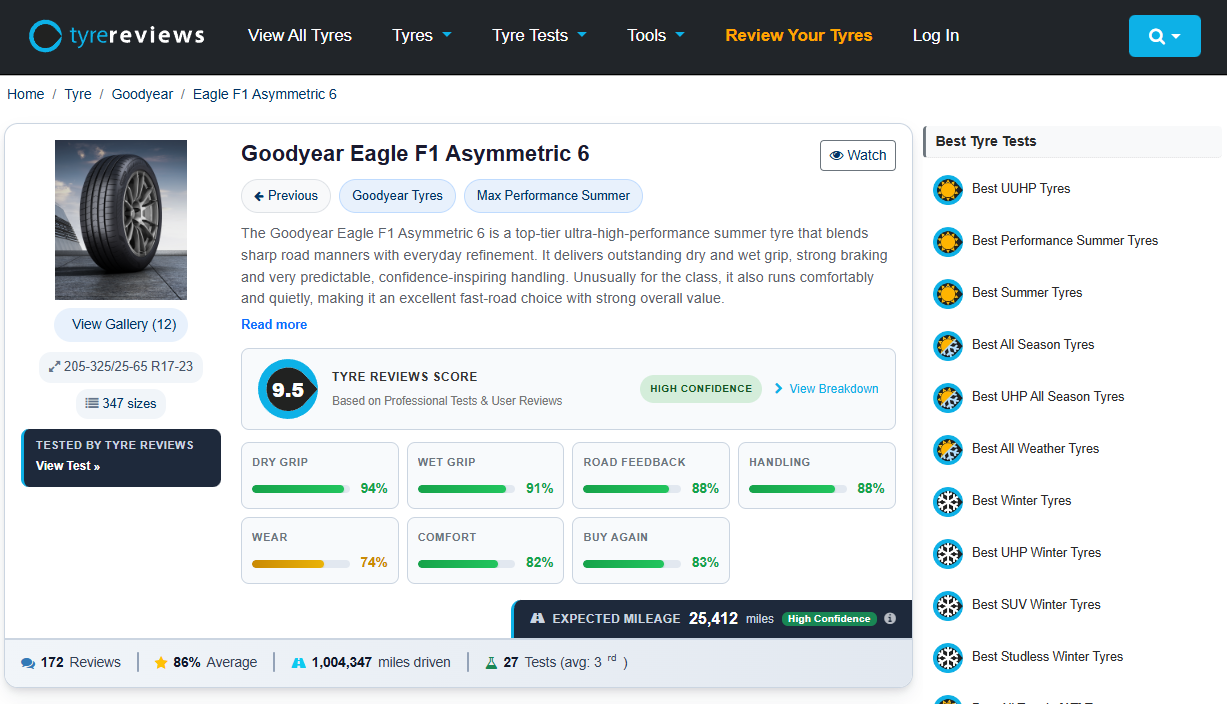
The widgets
The current set covers scores, reviews, summaries, comparisons, EU label data and a compact inline badge. A few examples:
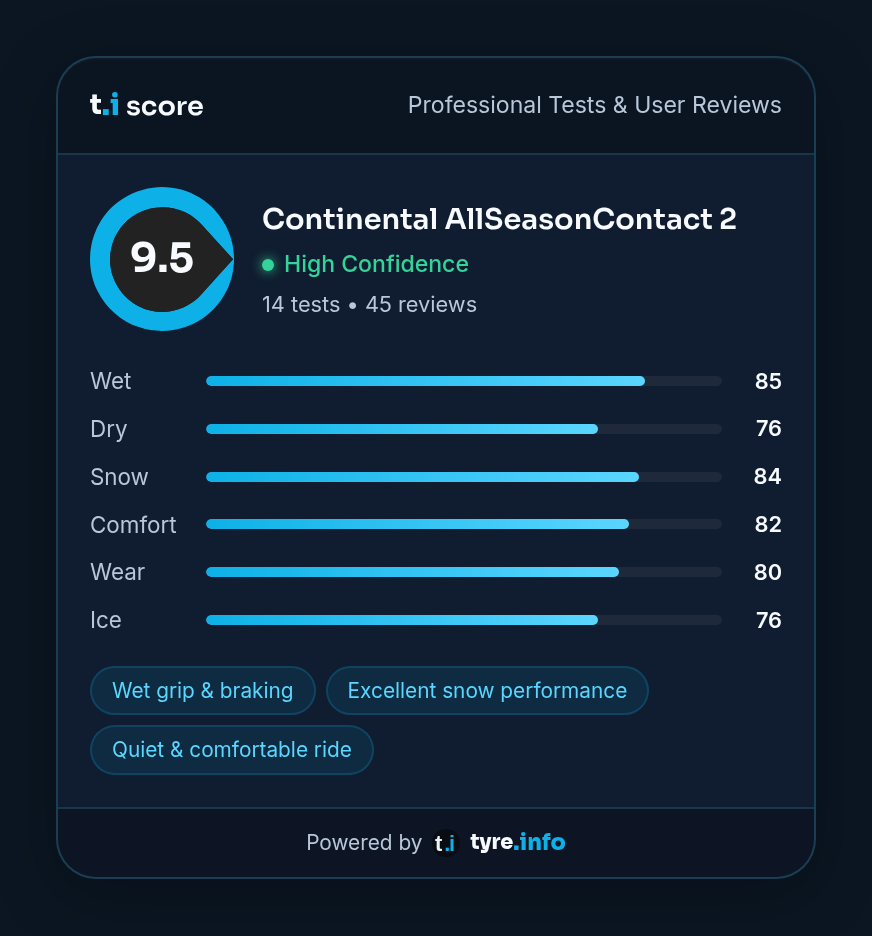
Score card
The score, its confidence tier, the number of tests and reviews behind it, and category bars. There is also a smaller badge version that opens the full breakdown in a modal.
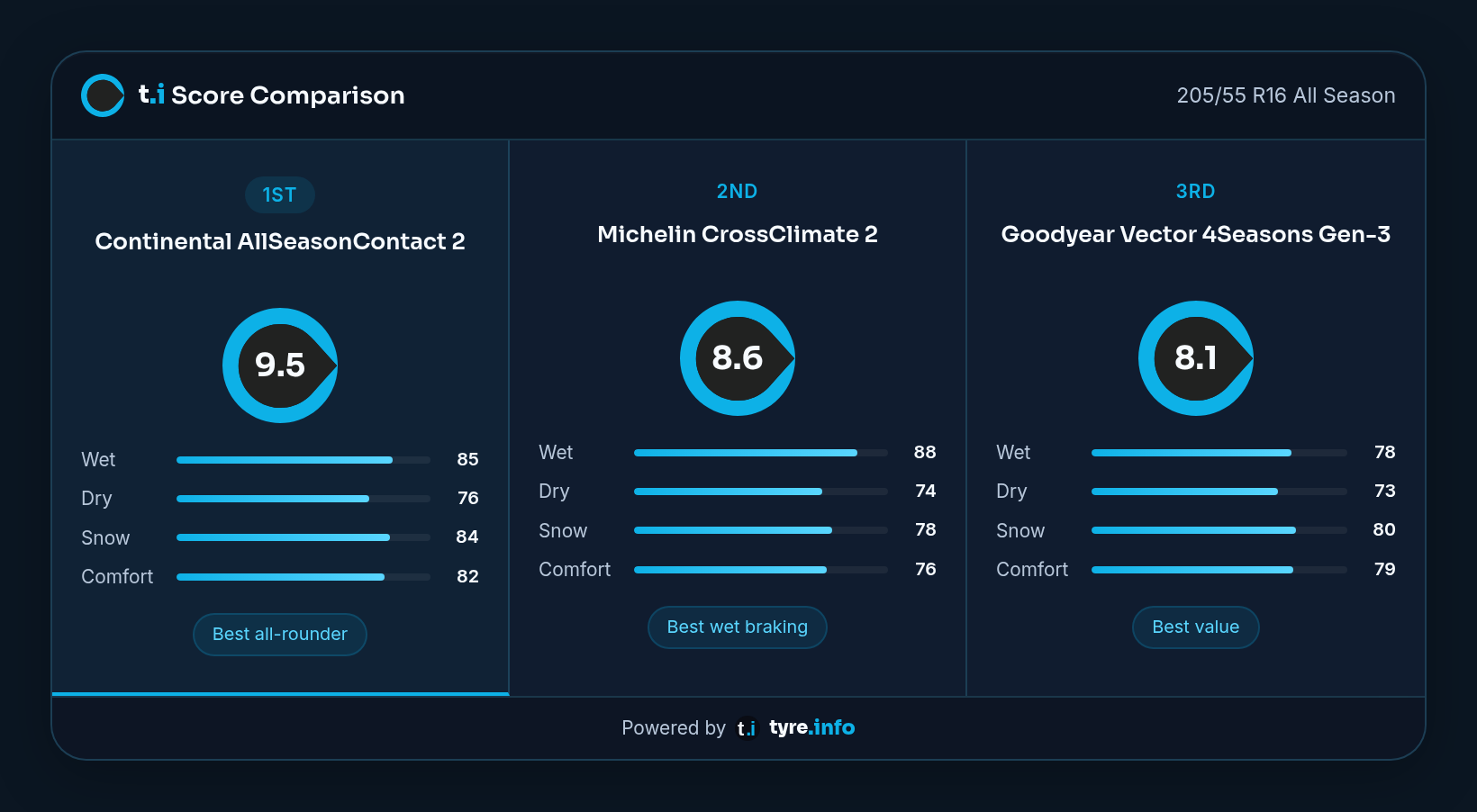
Comparison
Two or more tyres side by side with their scores and category breakdowns, for category pages, search results or a screen at the counter.
Summaries
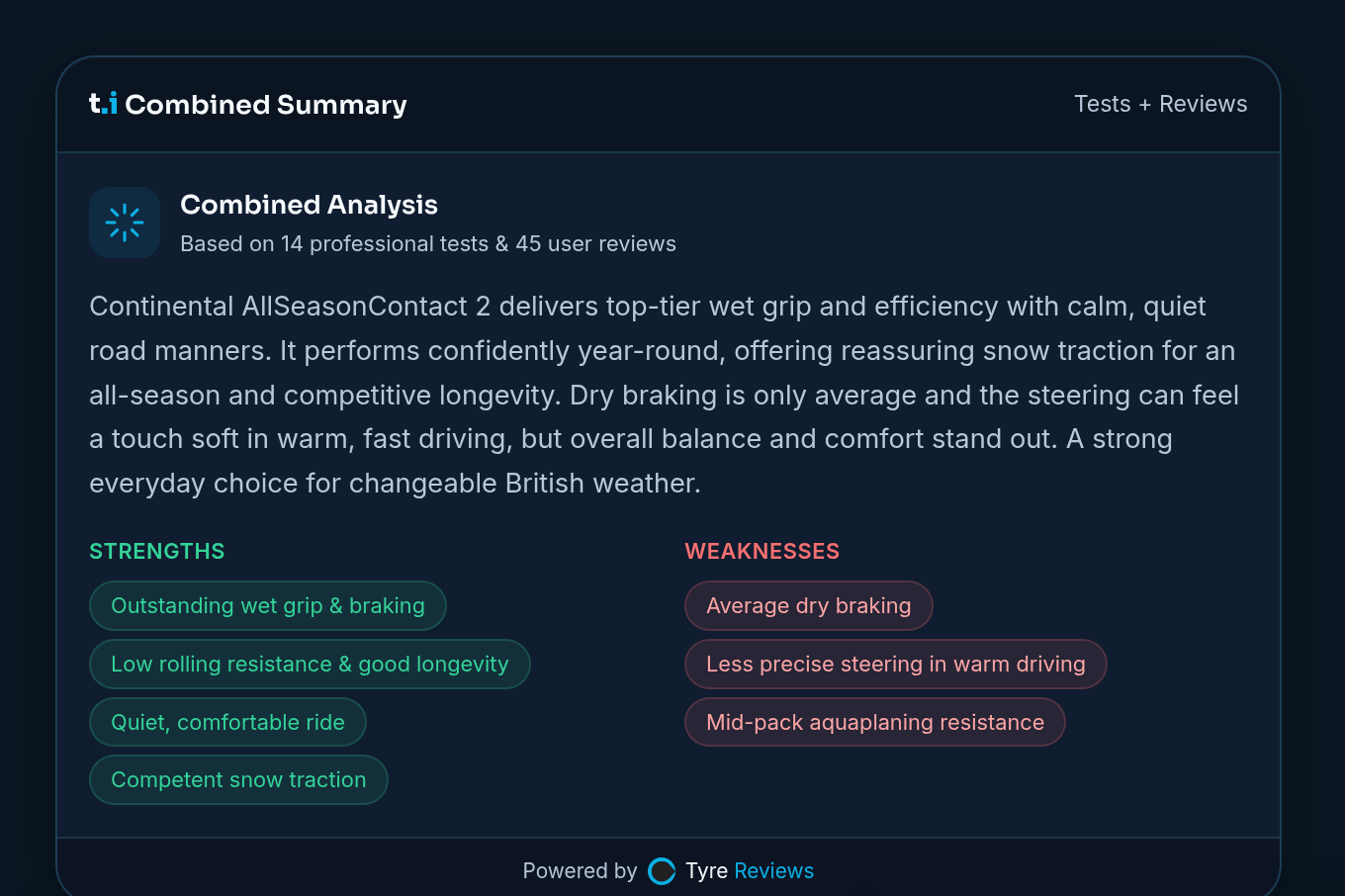
A written paragraph rather than a chart, available in three forms: what owners report, how the tyre performs under test, or the two combined, with strengths and weaknesses listed separately.
Reviews
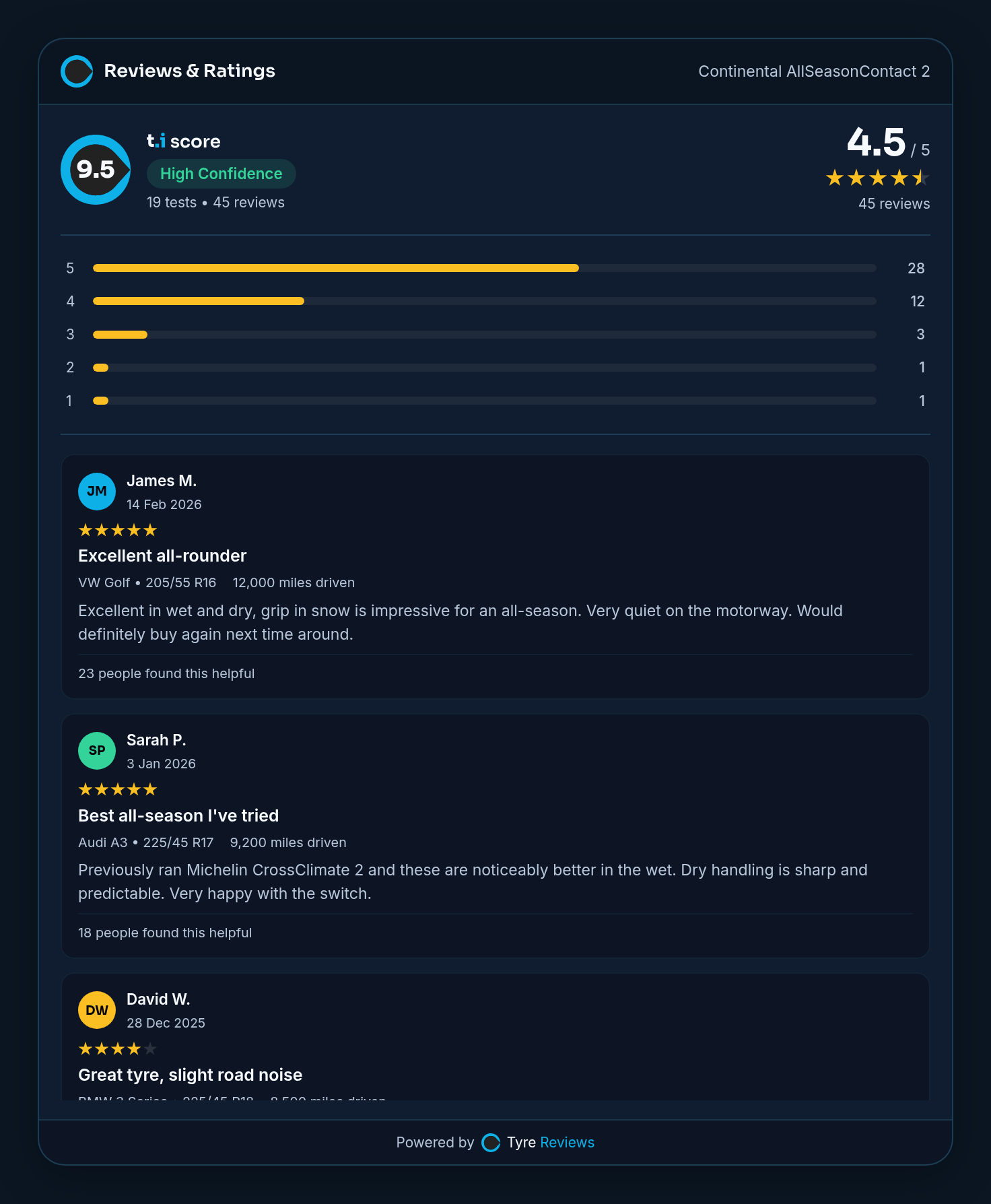
Owner reviews with star ratings, the rating distribution, and the car and mileage attached to each review. Critical reviews are included as well as positive ones.
Interactive versions of all of them, with embed code, are on the widget examples page. There are also retailer and manufacturer demo pages showing them on a mock product page.
API endpoints
The API covers the same data as the widgets, in seven languages: English, German, French, Spanish, Italian, Turkish and Swedish. It reads the production database, so a test published here appears through the API within hours.
| Endpoint | Returns |
|---|---|
/tyres/search | Search by pattern, brand, season or score |
/tyres/{id} | Full tyre detail with score breakdown and expected mileage |
/tyres/{id}/score | Overall score, confidence tier and data source |
/tyres/{id}/score-explanation | Category breakdowns, methodology version and written narrative |
/tyres/{id}/tests | Test positions and awards, with full metrics for Tyre Reviews tests |
/tyres/{id}/reviews | Owner reviews with ratings and statistics |
/tyres/{id}/images | Product images and video |
/tyres/{id}/alternatives | Known pattern names and alternative IDs for catalogue matching |
/brands | All brands with tyre counts |
/tests | Published tests |
The /alternatives endpoint tends to be the useful one for retailers, since the same tyre is often listed under different names by different suppliers and it exists to match a stock file against our tyre IDs.
Independence and terms
A few points that come up in most conversations, and which are published in full on the site:
- No manufacturer sees a score before publication, and there are no paid placements in any ranking. Licensing the data does not change a score.
- The scoring methodology is versioned, and changes to it are published and dated.
- The service contract can be read before signing, including the refund terms and the prohibition on using the data to train AI models.
- No end-user data is collected. Query parameters and response bodies are not logged and IP addresses are stored as one-way hashes. The privacy policy covers this in detail.
Pricing
There is a single plan at 500 euros per month, which covers 500,000 API requests a month, the full archive, all languages, widgets styled to your site and onboarding support. Larger integrations and custom endpoints are agreed separately.
Enquiries go through the form at data.tyre.info, and it helps to say up front whether it is for a retail site, a manufacturer site, a point of sale tool or an app, since those need different things from the same data.
Common questions
How quickly does new data appear?
Within hours. The API reads the same database that serves this site, so there is no separate export or sync step.
Can the widgets be styled to match our site?
Yes. The data and the presentation are separate, so widgets can be restyled, or the API can be used to build the interface from scratch.
What happens when a tyre has very little data behind it?
It gets a Limited or Medium confidence tier rather than a falsely precise score, and the integration decides how to handle that, whether that is showing the review count, using a lighter badge or hiding the module.
Is an API integration needed to start?
No. Most start with widgets on product pages, which is a script tag rather than a project, and move to the API later if they need more control.