Kumho Ecsta Sport PS72 vs Yokohama Advan Sport V107
The Yokohama repeatedly posts the best dry braking numbers in these head-to-heads, and in Autobild it also edges dry handling and subjective steering feel. The Kumho, however, keeps beating it where many drivers most need safety margin-wet braking and wet handling-while also delivering notably lower rolling resistance (efficiency) and stronger overall value. Those trade-offs heavily influence why the Kumho places much higher overall in the shared group tests (6th vs 13th in Autobild; 4th vs 18th in the braking super test; 5th vs 7th in Auto Express).
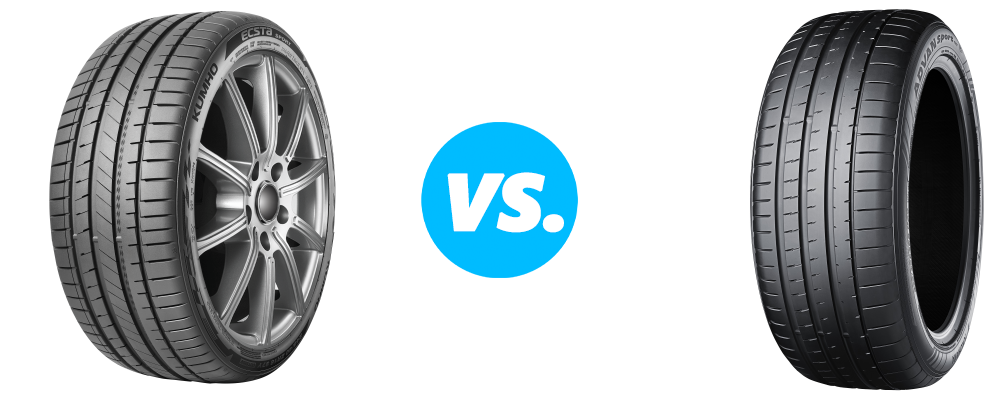
Test Results
Independent comparison tyre tests are the best source of data to get tyre information from, and the good news is there have been three tests which compare both tyres directly!
| Tyre | Test Wins | Performance |
|---|---|---|
| Kumho Ecsta Sport PS72 | three |
While it might look like the Kumho Ecsta Sport PS72 is better than the Yokohama Advan Sport V107 purely based on the higher number of test wins, tyres are very complicated objects which means where one tyre is better than the other can be more important in real world use.
Let's look at how the two tyres compare across multiple tyre test categories.
Key Strengths
- Wet braking advantage in the key 245/45 R19 tests (e.g., 42.4 m vs 47.9 m in Autobild; 27.1 m vs 30.6 m in the braking super test)
- More secure wet handling balance in Autobild (82.6 vs 82.0 km/h; subjective wet 8.7 vs 7.3) and faster wet circle (14.6 s vs 14.95 s)
- Lower rolling resistance/stronger efficiency in both tests that measured it (Autobild 8.15 vs 10.1 kg/t; Auto Express 7.36 vs 8.97 kg/t)
- Stronger ownership economics: better wear (48,230 km vs 45,630 km), better value metric (12.44 vs 14.03), and lower abrasion (1605 g vs 1794 g) in Autobild
- Consistent dry braking winner across all three shared tests (34.1 vs 34.4 m in Autobild; 34.1 vs 34.4 m in braking super test; 34.0 vs 36.8 m in Auto Express)
- Slight edge in outright dry handling and steering feel in Autobild (100.8 vs 100.0 km/h; subjective dry 8.7 vs 8.0)
- Often strong straight-line aquaplaning resistance (Autobild 93 vs 91 km/h; Auto Express 83.8 vs 83.6 km/h)
- Lower measured pass-by noise in Autobild (73.1 vs 74.1 dB), supporting a quieter cruise on smooth surfaces
Dry Braking
Looking at data from three tyre tests, the Yokohama Advan Sport V107 was better during three dry braking tests. On average the Yokohama Advan Sport V107 stopped the vehicle in 3.21% less distance than the Kumho Ecsta Sport PS72.
Best In Dry Braking: Yokohama Advan Sport V107
See how the Dry Braking winner was calculated >>
Dry Handling [s]
Looking at data from one tyre tests, the Kumho Ecsta Sport PS72 and Yokohama Advan Sport V107 performed equally well in dry handling [s] tests.
Best In Dry Handling [s]: Both tyres performed equally well
See how the Dry Handling winner was calculated >>
Dry Handling [Km/H]
Looking at data from one tyre tests, the Yokohama Advan Sport V107 was better during one dry handling [km/h] tests. On average the Yokohama Advan Sport V107 was 0.79% faster around a lap than the Kumho Ecsta Sport PS72.
Best In Dry Handling [Km/H]: Yokohama Advan Sport V107
See how the Dry Handling winner was calculated >>
Subj. Dry Handling
Looking at data from one tyre tests, the Yokohama Advan Sport V107 was better during one subj. dry handling tests. On average the Yokohama Advan Sport V107 scored 8.05% more points than the Kumho Ecsta Sport PS72.
Best In Subj. Dry Handling: Yokohama Advan Sport V107
See how the Subj. Dry Handling winner was calculated >>
Wet Braking
Looking at data from three tyre tests, the Kumho Ecsta Sport PS72 was better during two wet braking tests. On average the Kumho Ecsta Sport PS72 stopped the vehicle in 5.64% less distance than the Yokohama Advan Sport V107.
Best In Wet Braking: Kumho Ecsta Sport PS72
See how the Wet Braking winner was calculated >>
Wet Handling [s]
Looking at data from one tyre tests, the Kumho Ecsta Sport PS72 was better during one wet handling [s] tests. On average the Kumho Ecsta Sport PS72 was 0.98% faster around a wet lap than the Yokohama Advan Sport V107.
Best In Wet Handling [s]: Kumho Ecsta Sport PS72
See how the Wet Handling winner was calculated >>
Wet Handling [Km/H]
Looking at data from one tyre tests, the Kumho Ecsta Sport PS72 was better during one wet handling [km/h] tests. On average the Kumho Ecsta Sport PS72 was 0.73% faster around a wet lap than the Yokohama Advan Sport V107.
Best In Wet Handling [Km/H]: Kumho Ecsta Sport PS72
See how the Wet Handling winner was calculated >>
Subj. Wet Handling
Looking at data from one tyre tests, the Kumho Ecsta Sport PS72 was better during one subj. wet handling tests. On average the Kumho Ecsta Sport PS72 scored 16.09% more points than the Yokohama Advan Sport V107.
Best In Subj. Wet Handling: Kumho Ecsta Sport PS72
See how the Subj. Wet Handling winner was calculated >>
Wet Circle
Looking at data from two tyre tests, the Kumho Ecsta Sport PS72 was better during one wet circle tests. On average the Kumho Ecsta Sport PS72 was 0.14% faster around a wet circle than the Yokohama Advan Sport V107.
Best In Wet Circle: Kumho Ecsta Sport PS72
See how the Wet Circle winner was calculated >>
Straight Aqua
Looking at data from two tyre tests, the Yokohama Advan Sport V107 was better during two straight aqua tests. On average the Yokohama Advan Sport V107 floated at a 1.24% higher speed than the Kumho Ecsta Sport PS72.
Best In Straight Aqua: Yokohama Advan Sport V107
See how the Straight Aqua winner was calculated >>
Curved Aquaplaning
Looking at data from two tyre tests, the Kumho Ecsta Sport PS72 and Yokohama Advan Sport V107 performed equally well in curved aquaplaning tests.
Best In Curved Aquaplaning: Both tyres performed equally well
See how the Curved Aquaplaning winner was calculated >>
Subj. Comfort
Looking at data from one tyre tests, the Kumho Ecsta Sport PS72 and Yokohama Advan Sport V107 performed equally well in subj. comfort tests.
Best In Subj. Comfort: Both tyres performed equally well
See how the Subj. Comfort winner was calculated >>
Subj. Noise
Looking at data from one tyre tests, the Kumho Ecsta Sport PS72 was better during one subj. noise tests. On average the Kumho Ecsta Sport PS72 scored 12% more points than the Yokohama Advan Sport V107.
Best In Subj. Noise: Kumho Ecsta Sport PS72
See how the Subj. Noise winner was calculated >>
Noise
Looking at data from one tyre tests, the Yokohama Advan Sport V107 was better during one noise tests. On average the Yokohama Advan Sport V107 measured 1.35% quieter than the Kumho Ecsta Sport PS72.
Best In Noise: Yokohama Advan Sport V107
See how the Noise winner was calculated >>
Wear
Looking at data from one tyre tests, the Kumho Ecsta Sport PS72 was better during one wear tests. On average the Kumho Ecsta Sport PS72 is predicted to cover 5.39% miles before reaching 1.6mm than the Yokohama Advan Sport V107.
Best In Wear: Kumho Ecsta Sport PS72
See how the Wear winner was calculated >>
Value
Looking at data from one tyre tests, the Kumho Ecsta Sport PS72 was better during one value tests. On average the Kumho Ecsta Sport PS72 proved to have a 11.33% better value based on price/1000km than the Yokohama Advan Sport V107.
Best In Value: Kumho Ecsta Sport PS72
See how the Value winner was calculated >>
Rolling Resistance
Looking at data from two tyre tests, the Kumho Ecsta Sport PS72 was better during two rolling resistance tests. On average the Kumho Ecsta Sport PS72 had a 18.66% lower rolling resistance than the Yokohama Advan Sport V107.
Best In Rolling Resistance: Kumho Ecsta Sport PS72
See how the Rolling Resistance winner was calculated >>
Abrasion
Looking at data from one tyre tests, the Kumho Ecsta Sport PS72 was better during one abrasion tests. On average the Kumho Ecsta Sport PS72 lost 10.54% less particle wear matter than the Yokohama Advan Sport V107.
Best In Abrasion: Kumho Ecsta Sport PS72
See how the Abrasion winner was calculated >>
Real World Driver Reviews
Kumho Ecsta Sport PS72 Driver Reviews
Drivers generally report the Kumho Ecsta Sport PS72 delivers strong dry and wet grip with confident, predictable handling and very good steering precision for the price. Many describe it as comparable to premium options (e.g., Michelin Pilot Sport and Goodyear Eagle F1 Asymmetric lines) while offering standout value. Noise and comfort are often rated as good to very good, though a minority note it can be a bit firm or road-noisy depending on car/road. The main recurring complaint is vibration/balancing problems (often described as out-of-round tyres) on some sets, which can undermine an otherwise very positive experience.
Based on 27 reviews with an average rating of 84%
Yokohama Advan Sport V107 Driver Reviews
Drivers generally describe the Yokohama Advan Sport V107 as a very sporty max-performance summer tyre with strong dry grip, sharp steering, and confident handling/feedback that can hold up surprisingly well for occasional track use. Many also report good wet traction, though several note reduced confidence in colder conditions and some aquaplaning as the tyre wears. The most consistent drawbacks are short tread life for a “premium” tyre and higher road noise/roar on coarse pavement, especially at highway speeds.
Based on 20 reviews with an average rating of 73%
They are not loud, but wouldn't they are necessarily quiet. You can hear them a bit depending on the road surface and speed.
Didn’t drive them too much in the rain, but seem to hold pretty well in wet conditions.
Mounted them in march this year and after 10-15k km I don’t see any major wear, but I would have to abstain on this one until I get them properly... Continue reading this review using the link below
Conclusion
The Yokohama Advan Sport V107's case is narrower but still valid: if your priority is dry-road stopping performance and crisp, confidence-building dry handling feel, it repeatedly delivers. It wins dry braking in all three shared tests (including a large 7.6% advantage in Auto Express: 34.0 m vs 36.8 m), and it can be strong in aquaplaning resistance in a straight line (Autobild: 93 vs 91 km/h). The issue is that its weaker wet handling in Autobild and higher energy consumption undermine its “premium” proposition for everyday use.
Practical takeaway: the Kumho is the smarter, safer-feeling daily performance tyre for mixed summer conditions and cost-conscious drivers (including EV owners sensitive to efficiency), while the Yokohama is best reserved for drivers who predominantly chase dry-road braking/response and are willing to accept higher rolling resistance and more variable wet balance.
Key Differences
- Wet safety margin (biggest real-world gap): Autobild wet braking 42.4 m (Kumho) vs 47.9 m (Yokohama), ~5.5 m difference in the same size test
- Dry braking is consistently Yokohama's trump card: it wins 3/3 dry braking comparisons, including a large advantage in Auto Express (34.0 m vs 36.8 m)
- Efficiency/running costs strongly favor Kumho: rolling resistance is substantially lower (Autobild 8.15 vs 10.1 kg/t; Auto Express 7.36 vs 8.97 kg/t), and Autobild flags Yokohama's rolling resistance as a primary drawback
- Overall test outcome pattern favors Kumho: higher overall placements in every shared test (6th vs 13th; 4th vs 18th; 5th vs 7th)
- Wet handling balance differs by test but trends toward Kumho in the harsher Autobild metrics (and subjective wet), while Yokohama can look more mixed/mid-pack in the wet depending on discipline
- Value proposition diverges: Kumho posts better wear and cost metrics in Autobild (48,230 km vs 45,630 km; value 12.44 vs 14.03), while Yokohama's performance advantages are narrower and more dry-focused
Overall Winner: Kumho Ecsta Sport PS72
Based on the tyre test data and user reviews we have in our database, the Kumho Ecsta Sport PS72 has demonstrated better overall performance in this comparison. However, as you can see from the spider diagram above, each tyre has its own strengths which should be considered in your final tyre buying choice.Similar Comparisons
Looking for more tyre comparisons? Here are other direct comparisons involving these tyres:



Footnote
This page has been developed using tyre industry testing best practices. This means we are only comparing tests which have had both tyres in the same test.
Why is this important? Tyre testing is heavily affected by things like surface grip levels and surface temperature, which means you can only compare values from the same day. During a tyre test external condition changes are calculated into the overall results, but it is not possible to calculate this between tyre tests performed on different days or at different locations.
As a result you will see other tests on Tyre Reviews which feature both the %s and %s, but as they weren't conducted on the same day, the results are not comparable.
Lots of other websites do this sort of tyre comparison, Tyre Reviews doesn't.
Discussion
- No comments yet — be the first.