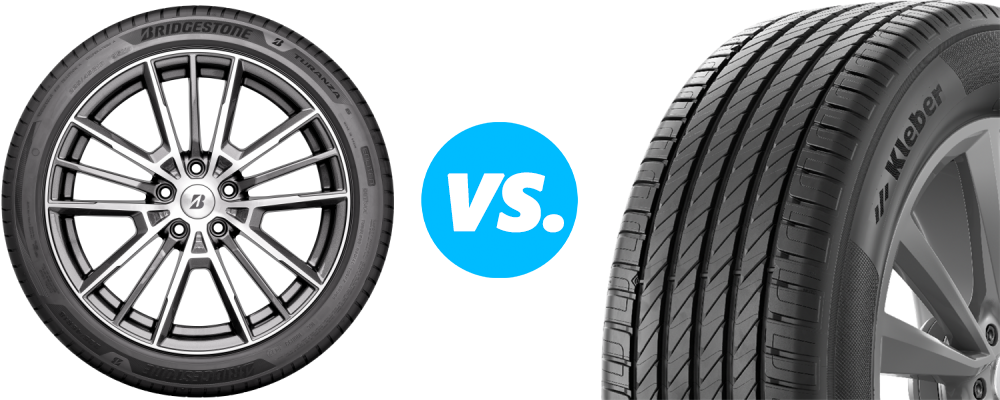
Bridgestone Turanza 6 vs Kleber Dynaxer HP5
Across the two shared 225/45 R17 summer tests (Motor 2026 and a 2026 group test with an eco award), the story is consistent: Turanza 6 repeatedly wins on energy efficiency and is marginally better in dry braking, but the Kleber repeatedly outperforms it in wet braking/handling and also scores better for subjective comfort. If your priorities include wet confidence and “easy” everyday dynamics, this comparison leans more strongly one way than the brand badges might suggest.
Test Results
Independent comparison tyre tests are the best source of data to get tyre information from, and the good news is there have been two tests which compare both tyres directly!
| Tyre | Test Wins | Performance |
|---|---|---|
| Bridgestone Turanza 6 | one | |
| Kleber Dynaxer HP5 | one |
The Bridgestone Turanza 6 and Kleber Dynaxer HP5 have an equal number of test wins. However, tyres are very complicated objects which means where one tyre is better than the other can be more important in real world use.
Let's look at how the two tyres compare across multiple tyre test categories.
Key Strengths
- Class-leading rolling resistance/efficiency (about 17-18% lower RR than Kleber in both tests)
- Slightly shorter dry braking in both tests (37.4 m vs 38.0 m; 37.45 m vs 37.98 m)
- Generally stable, touring-focused and predictable at the limit (no single catastrophic weakness in the datasets)
- Can rank well overall when efficiency is heavily weighted (eco award; 4/13 in the larger 2026 test)
- Stronger wet braking and wet handling in both tests (consistent advantage across key wet metrics)
- Better straight-line aquaplaning resistance in both tests (73.38-73.4 km/h vs 72.2-72.24 km/h)
- More engaging/faster handling balance (wins dry handling times in both tests; subjectively rated slightly higher)
- Higher comfort scores in both tests (6.9 vs 6.2 and 6.9 vs 6.6), giving a more relaxed daily-drive feel
Dry Braking
Looking at data from two tyre tests, the Bridgestone Turanza 6 was better during two dry braking tests. On average the Bridgestone Turanza 6 stopped the vehicle in 1.47% less distance than the Kleber Dynaxer HP5.
Best In Dry Braking: Bridgestone Turanza 6
See how the Dry Braking winner was calculated >>
Dry Handling [s]
Looking at data from two tyre tests, the Kleber Dynaxer HP5 was better during two dry handling [s] tests. On average the Kleber Dynaxer HP5 was 0.78% faster around a lap than the Bridgestone Turanza 6.
Best In Dry Handling [s]: Kleber Dynaxer HP5
See how the Dry Handling winner was calculated >>
Subj. Dry Handling
Looking at data from two tyre tests, the Kleber Dynaxer HP5 was better during one subj. dry handling tests. On average the Kleber Dynaxer HP5 scored 0.69% more points than the Bridgestone Turanza 6.
Best In Subj. Dry Handling: Kleber Dynaxer HP5
See how the Subj. Dry Handling winner was calculated >>
Wet Braking
Looking at data from two tyre tests, the Kleber Dynaxer HP5 was better during two wet braking tests. On average the Kleber Dynaxer HP5 stopped the vehicle in 1.27% less distance than the Bridgestone Turanza 6.
Best In Wet Braking: Kleber Dynaxer HP5
See how the Wet Braking winner was calculated >>
Wet Handling [s]
Looking at data from two tyre tests, the Kleber Dynaxer HP5 was better during two wet handling [s] tests. On average the Kleber Dynaxer HP5 was 1.41% faster around a wet lap than the Bridgestone Turanza 6.
Best In Wet Handling [s]: Kleber Dynaxer HP5
See how the Wet Handling winner was calculated >>
Subj. Wet Handling
Looking at data from one tyre tests, the Kleber Dynaxer HP5 was better during one subj. wet handling tests. On average the Kleber Dynaxer HP5 scored 9.76% more points than the Bridgestone Turanza 6.
Best In Subj. Wet Handling: Kleber Dynaxer HP5
See how the Subj. Wet Handling winner was calculated >>
Wet Circle
Looking at data from one tyre tests, the Bridgestone Turanza 6 and Kleber Dynaxer HP5 performed equally well in wet circle tests.
Best In Wet Circle: Both tyres performed equally well
See how the Wet Circle winner was calculated >>
Straight Aqua
Looking at data from two tyre tests, the Kleber Dynaxer HP5 was better during two straight aqua tests. On average the Kleber Dynaxer HP5 floated at a 1.59% higher speed than the Bridgestone Turanza 6.
Best In Straight Aqua: Kleber Dynaxer HP5
See how the Straight Aqua winner was calculated >>
Curved Aquaplaning
Looking at data from two tyre tests, the Bridgestone Turanza 6 and Kleber Dynaxer HP5 performed equally well in curved aquaplaning tests.
Best In Curved Aquaplaning: Both tyres performed equally well
See how the Curved Aquaplaning winner was calculated >>
Subj. Comfort
Looking at data from two tyre tests, the Kleber Dynaxer HP5 was better during two subj. comfort tests. On average the Kleber Dynaxer HP5 scored 7.25% more points than the Bridgestone Turanza 6.
Best In Subj. Comfort: Kleber Dynaxer HP5
See how the Subj. Comfort winner was calculated >>
Noise
Looking at data from two tyre tests, the Bridgestone Turanza 6 was better during one noise tests. On average the Bridgestone Turanza 6 measured 0.29% quieter than the Kleber Dynaxer HP5.
Best In Noise: Bridgestone Turanza 6
See how the Noise winner was calculated >>
Rolling Resistance
Looking at data from two tyre tests, the Bridgestone Turanza 6 was better during two rolling resistance tests. On average the Bridgestone Turanza 6 had a 17.25% lower rolling resistance than the Kleber Dynaxer HP5.
Best In Rolling Resistance: Bridgestone Turanza 6
See how the Rolling Resistance winner was calculated >>
Real World Driver Reviews
Tyre Reviews also collects real world driver reviews for the Bridgestone Turanza 6 and Kleber Dynaxer HP5.
In total the Bridgestone Turanza 6 has been reviewed 52 times and drivers have given the tyre 79% overall.
The Kleber Dynaxer HP5 has been reviewed 5 times and drivers have given the tyre 87% overall.
This means in real world driving, people prefer the Kleber Dynaxer HP5.
Conclusion
The Bridgestone Turanza 6's clear justification is efficiency. It posts class-leading rolling resistance in both tests (roughly a ~17-18% advantage: 0.632 vs 0.77 kg/t, and 6.46 vs 7.81 kg/t), earning an “eco specialist” nod and making it the better pick for high-mileage drivers prioritizing fuel/EV range. The trade-off is that, despite being perfectly “adequate,” it doesn't deliver the wet bite and lap-time pace expected at its premium positioning; test notes explicitly mention a lack of bite and some hydroplaning moments. Practical takeaway: choose Turanza 6 for energy saving first, but choose Dynaxer HP5 if your daily reality includes heavy rain, cool mornings, and you value reassuring wet behaviour more than squeezing out a few percent in efficiency.
Key Differences
- Wet performance is the divider: Kleber wins wet braking and wet handling in both tests, while Bridgestone is repeatedly described as lacking wet bite.
- Efficiency is the counterpoint: Bridgestone dominates rolling resistance (about a 17-18% advantage), which can translate to real fuel/EV-range savings.
- Dry braking narrowly favours Bridgestone in both datasets, but the margins are small (roughly half a metre).
- Dry handling pace favours Kleber in both tests (small but consistent), suggesting a more confident front-end and willingness to rotate.
- Comfort consistently favours Kleber (notably +11% in Motor's subjective comfort score), aligning with its “easy, smooth” character.
- Overall ranking depends on scoring emphasis: Bridgestone places higher in the larger test (4/13) when efficiency is rewarded, while Kleber places ahead in the Motor test (7/9 vs 8/9) on more rounded dynamic performance.
Overall Winner: Kleber Dynaxer HP5
Based on the tyre test data and user reviews we have in our database, the Kleber Dynaxer HP5 has demonstrated better overall performance in this comparison. However, as you can see from the spider diagram above, each tyre has its own strengths which should be considered in your final tyre buying choice.Similar Comparisons
Looking for more tyre comparisons? Here are other direct comparisons involving these tyres:


Footnote
This page has been developed using tyre industry testing best practices. This means we are only comparing tests which have had both tyres in the same test.
Why is this important? Tyre testing is heavily affected by things like surface grip levels and surface temperature, which means you can only compare values from the same day. During a tyre test external condition changes are calculated into the overall results, but it is not possible to calculate this between tyre tests performed on different days or at different locations.
As a result you will see other tests on Tyre Reviews which feature both the %s and %s, but as they weren't conducted on the same day, the results are not comparable.
Lots of other websites do this sort of tyre comparison, Tyre Reviews doesn't.
Discussion
- No comments yet — be the first.