



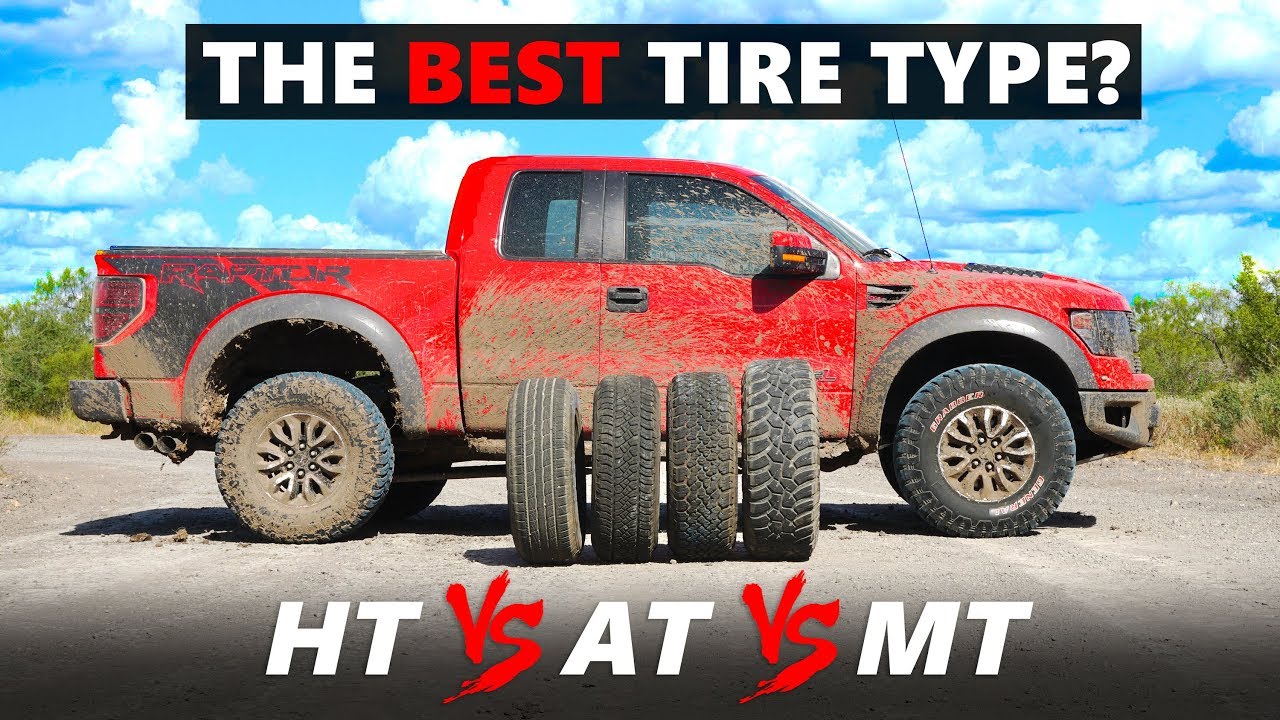
Highway terrain (HT) tyres are the best choice for an SUV or pickup that spends most of its life on the road, mud terrain (MT) tyres are the only real choice if you regularly drive in mud, and all terrain (AT) tyres sit in between. To put numbers on that trade-off, I tested one tyre of each type back to back on the same truck, on road and off road, and measured exactly what you gain and lose as the tread gets more aggressive.
All four tyres came from General Tire's Grabber range, which kept the construction philosophy as consistent as possible: the Grabber HTS60 highway tyre, the Grabber APT mild all terrain, the Grabber ATx aggressive all terrain and the Grabber X3 mud terrain, all in 265/70 R17. I also ran the Grabber X3 in a much bigger LT315/70 R17 size, shown in the charts as "Reference MT Mud Terrain", to see what fitting bigger tyres does. The truck was a Ford F-150 Raptor, and the testing took six days at General Tire's off-road proving ground in Texas, covering dry and wet braking and handling, aquaplaning, hard-packed dirt, gravel, mud traction, comfort, noise, weight and rolling resistance.
Test setup & methodology
The test setting, the conditions recorded and how the results contribute to the score.
Show full testing methodology
Score Weighting
Weights express the scoring priorities, not how much each discipline actually changed the finishing order. The size of the performance gaps matters too. Category weights contribute to the overall score. Within each category, discipline weights divide that category’s share. Published finishing positions also need to be read alongside the editorial verdict.
| Test | Within category | Share of overall score |
|---|---|---|
| Dry · 36% | ||
| Dry Braking | 46% | 16.56% |
| Dry Handling | 45% | 16.2% |
| Subj. Dry Handling | 9% | 3.24% |
| Wet · 50% | ||
| Wet Braking | 40% | 20% |
| Wet Handling | 40% | 20% |
| Subj. Wet Handling | 10% | 5% |
| Straight Aqua | 10% | 5% |
| Comfort · 7% | ||
| Subj. Comfort | 83% | 5.81% |
| Tyre Weight | 17% | 1.19% |
| Value · 7% | ||
| Rolling Resistance | 100% | 7% |
Our standard methods
The conditions above are recorded for this test. The descriptions below explain our standard procedures; measurement windows and run counts can vary by test.
Dry Braking
For dry braking, I drive the test vehicle at an entry speed of 110 km/h and apply full braking effort to a standstill with ABS active on clean, dry asphalt. I typically use an 100–5 km/h measurement window. My standard programme is five runs per tyre set where possible, although the sequence can extend to as many as fifteen runs if conditions and tyre category justify it. I analyse the full set of runs and discard statistical outliers before averaging. Reference tyres are run repeatedly throughout the session to correct for changing conditions.
Dry Handling
For dry handling, I drive at the limit of adhesion around a dedicated handling circuit with ESC disabled where possible so I can assess the tyre's natural balance, transient response, and limit behaviour without electronic intervention masking the result. I usually complete between two and five timed laps per tyre set, depending on the circuit, tyre type, and consistency of conditions. I exclude laps affected by clear driver error or obvious environmental inconsistency. Control runs are carried out frequently throughout the session, and I often use multiple sets of control tyres so that wear on the references does not become a meaningful variable. For more track-focused products, I also do endurance testing, which is a set number of laps at race pace to determine tire wear patterns and heat resistance over longer driving.
Subj. Dry Handling
I also carry out a structured subjective handling assessment at the limit of adhesion on a dedicated dry handling circuit. I score steering precision, steering response, turn-in behaviour, mid-corner balance, corner-exit traction, breakaway characteristics, and overall confidence using a standardised 1–10 scale used consistently across my testing. The final assessment combines numeric scoring with written technical commentary. I complete familiarisation laps on the control tyre before evaluating each candidate.
Wet Braking
For wet braking, I drive the test vehicle at an entry speed of 88 km/h and apply full braking effort to a standstill with ABS active on an asphalt surface with a controlled water film. I typically use an 80–5 km/h measurement window to isolate tyre performance from variability in the initial brake application. My standard programme is eight runs per tyre set where possible, although the sequence can extend to as many as fifteen runs if conditions and tyre category justify it. I analyse the full set of runs and discard statistical outliers before averaging. To correct for changing conditions, I run reference tyres repeatedly throughout the session — in wet testing, typically every three candidate test sets.
Wet Handling
For wet handling, I drive at the limit of adhesion around a dedicated handling circuit. I generally use specialist wet circuits with kerb-watering systems designed to maintain a consistent surface condition. ESC is disabled where possible so I can assess the tyre's natural balance, transient response, and limit behaviour without electronic intervention masking the result. I usually complete between two and five timed laps per tyre set, depending on the circuit, tyre type, and consistency of conditions. I exclude laps affected by clear driver error or obvious environmental inconsistency. Control runs are carried out frequently throughout the session, and I often use multiple sets of control tyres so that wear on the references does not become a meaningful variable.
Subj. Wet Handling
I also carry out a structured subjective handling assessment at the limit of adhesion on a dedicated wet handling circuit. I score steering precision, steering response, turn-in behaviour, mid-corner balance, aquaplaning resistance, breakaway characteristics, and overall confidence using a standardised 1–10 scale used consistently across my testing. The final assessment combines numeric scoring with written technical commentary. I complete familiarisation laps on the control tyre before evaluating each candidate.
Straight Aqua
To measure straight-line aquaplaning resistance, I drive one side of the vehicle through a water trough of controlled depth, typically around 7 mm, while the opposite side remains on dry pavement. I enter at a fixed speed and then accelerate progressively. I define aquaplaning onset as the point at which the wheel travelling through the water exceeds a specified slip threshold relative to the dry-side reference wheel. I usually perform four runs per tyre set and average the valid results.
Gravel Handling
For gravel handling, I drive at the limit of adhesion around a dedicated gravel handling course with ESC typically disabled. I complete multiple timed laps per tyre set, excluding laps affected by driver error or environmental inconsistency. Because natural surfaces are inherently variable, I place particular emphasis on repeat runs, careful reference tracking, and averaged results. The control tyre is retested at regular intervals throughout the session.
Subj. Gravel Handling
I also carry out a structured subjective handling assessment on a dedicated gravel course. I score steering feel, traction, stability, breakaway characteristics, and overall confidence using a standardised 1–10 scale used consistently across my testing. The final assessment combines numeric scoring with written technical commentary. I complete familiarisation laps on the control tyre before evaluating each candidate.
Dirt Handling
For dirt handling, I drive at the limit of adhesion around a dedicated dirt handling course with ESC typically disabled. I complete multiple timed laps per tyre set, excluding laps affected by driver error or environmental inconsistency. Because natural surfaces are inherently variable, I place particular emphasis on repeat runs, careful reference tracking, and averaged results. The control tyre is retested at regular intervals.
Subj. Dirt Handling
I also carry out a structured subjective handling assessment on a dedicated dirt course. I score steering feel, traction, stability, breakaway characteristics, and overall confidence using a standardised 1–10 scale used consistently across my testing. The final assessment combines numeric scoring with written technical commentary. I complete familiarisation laps on the control tyre before evaluating each candidate.
Mud Performance
To assess mud performance, I use a dedicated off-road mud section that is actively watered and maintained to a defined condition. The test focuses on the tyre's ability to generate forward traction through the section under controlled conditions. Performance is measured using acceleration time, distance covered, or both, depending on the specific format of the programme. Multiple runs are completed and averaged, with the mud section refreshed as necessary to maintain consistency.
Subj. Comfort
To assess comfort, I drive on a wide range of road surfaces (often dedicated comfort tracks at test facilities) at speeds from 50 to 120 km/h, including smooth motorway, coarse surfaces, expansion joints, broken pavement, and sharp-edged obstacles. I evaluate primary ride quality, secondary ride quality, impact harshness, seat-transmitted vibration, and the tyre's ability to absorb sharp inputs. Ratings are assigned on a 1–10 scale relative to the reference tyre.
Rolling Resistance
Rolling resistance is measured under controlled laboratory conditions in accordance with ISO 28580 and UNECE Regulation 117 Annex 6. The tyre is mounted on a test wheel and loaded against a large-diameter steel drum. After thermal stabilisation at the prescribed test speed, rolling resistance force is measured at the spindle and corrected according to the relevant procedure. The result is expressed as rolling resistance coefficient, typically in kg/tonne.
This test was run in partnership with General Tire in 2019, and every tyre is from their range, so it answers the question "which type of tyre?" rather than "which brand?". If you want to know which all terrain tyre to buy, my 2026 all terrain tyre test compares the latest models from every major brand. The overall result here is weighted towards road driving, and you can change the score weighting to match how you use your own vehicle.
What is the difference between HT, AT and MT tyres?
The difference is how much of the tread is rubber and how much is gap (void). A highway terrain tyre has a closed, road-car style tread with lots of rubber in contact with the surface, which is what you need for braking and grip on tarmac. As you move to a mild all terrain, an aggressive all terrain and then a mud terrain, the blocks get bigger and the gaps between them get wider, so the tyre can dig into loose surfaces and clear mud out of the tread. Mud terrain tyres also tend to use a heavier, stronger construction for puncture resistance, which makes them heavier. Every step towards off-road ability takes rubber away from the road, and this test measures what that costs.
Dry Braking
The Grabber HTS60 highway tyre stopped shortest in the dry at 46 metres. The mild all terrain Grabber APT was the best of the rest at 47.9 metres, and the Grabber X3 mud terrain and Grabber ATx aggressive all terrain were very close together at 48.1 and 48.5 metres. That means the most off-road focused tyres needed around 2 to 2.5 metres more to stop than the road tyre, which is roughly 5% further. The reason is simple: less rubber on the road means less grip under braking.
Dry Braking
Dry braking in meters
Lower is better ↓| Position / Tyre | Result | Gap to best |
|---|---|---|
| 46 m | Best | |
| 47.9 m | +1.90 m | |
| 48.1 m | +2.10 m | |
| 48.5 m | +2.50 m |
The difference between best and worst was 5.4% (2.5 m ≈ 0.6 Car Lengths).
Dry Handling
Dry handling was the biggest surprise on the road. The mild all terrain Grabber APT set the fastest lap at 100.84s, just 0.14s ahead of the Grabber HTS60, so the APT essentially matched the road tyre for grip. The road tyre still felt the more precise and sporty of the two, which is why it scored higher subjectively, but the APT did a very good job of clinging on.
Dry Handling
Dry handling time in seconds
Lower is better ↓| Position / Tyre | Result | Gap to best |
|---|---|---|
| 100.84 s | Best | |
| 100.98 s | +0.14 s | |
| 102.32 s | +1.48 s | |
RefReference MT Mud Terrain |
102.5 s | +1.66 s |
| 103.63 s | +2.79 s |
All the tyres in the Dry Handling test finished less than 3% apart.
The two more aggressive tyres dropped both time and feel. The Grabber ATx lapped in 102.32s and the small Grabber X3 in 103.63s, almost 2.8 seconds behind the APT, and both lost steering feel and feedback. The big LT315/70 R17 X3 was 1.1s faster than the small X3 at 102.5s, and it scored higher subjectively too. More rubber on the road gave it roughly the dry grip of the aggressive all terrain.
Subj. Dry Handling
Subjective Dry Handling Score
Higher is better ↑| Position / Tyre | Result | Gap to best |
|---|---|---|
| 10 Points | Best | |
| 9.8 Points | -0.20 Points | |
| 8 Points | -2.00 Points | |
RefReference MT Mud Terrain |
7.9 Points | -2.10 Points |
| 7.2 Points | -2.80 Points |
The difference between best and worst was 28% (2.8 Points).
Wet Braking
Wet braking is where the compromise is clearest. The Grabber HTS60 stopped in 59.3 metres, and the three off-road tyres in the same size needed between 64.2 and 65.7 metres. That is between 4.9 and 6.4 metres further, or 8 to 11%, with the aggressive all terrain Grabber ATx the longest. In an emergency stop in the rain that is the difference between stopping short of something and hitting it at speed.
Wet Braking
Wet braking in meters
Lower is better ↓| Position / Tyre | Result | Gap to best |
|---|---|---|
| 59.3 m | Best | |
RefReference MT Mud Terrain |
63 m | +3.70 m |
| 64.2 m | +4.90 m | |
| 65 m | +5.70 m | |
| 65.7 m | +6.40 m |
The difference between best and worst was 10.8% (6.4 m ≈ 1.4 Car Lengths).
The big LT315/70 R17 X3 stopped in 63 metres, second best and shorter than any of the smaller off-road tyres. Wider tyres put more rubber on the road, and here that was enough to lift the mud terrain above both all terrains. If you spend most of your time on the road, this is the test to think about before fitting a more aggressive tyre just because it looks better.
Wet Handling
The results in wet handling followed the tread patterns in a very logical order. The Grabber HTS60 was fastest by a clear margin at 82.2s, and it was the most direct and enjoyable tyre to drive. Every step towards a more aggressive tread made the handling a little worse and the grip drop off, but the other three were close together: the Grabber APT lapped in 85.2s, the Grabber ATx in 85.9s and the Grabber X3 in 86.6s, all within 1.4 seconds. The big X3 was right in that group at 86.0s.
Wet Handling
Wet handling time in seconds
Lower is better ↓| Position / Tyre | Result | Gap to best |
|---|---|---|
| 82.2 s | Best | |
| 85.2 s | +3.00 s | |
| 85.9 s | +3.70 s | |
RefReference MT Mud Terrain |
86 s | +3.80 s |
| 86.6 s | +4.40 s |
The difference between best and worst was 5.4% (4.4 s).
Subj. Wet Handling
Subjective Wet Handling Score
Higher is better ↑| Position / Tyre | Result | Gap to best |
|---|---|---|
| 10 Points | Best | |
| 9 Points | -1.00 Points | |
| 8.5 Points | -1.50 Points | |
| 8 Points | -2.00 Points | |
RefReference MT Mud Terrain |
8 Points | -2.00 Points |
The difference between best and worst was 20% (2 Points).
Aquaplaning
Aquaplaning reversed the road-tyre story. The Grabber X3 mud terrain dominated at 105.1 km/h, because its large, open tread blocks clear water much more efficiently. That was 12.2 km/h better than the Grabber APT in second at 92.9 km/h. The Grabber HTS60 was third at 89.1 km/h, and the Grabber ATx aggressive all terrain was last at 86.1 km/h, so more void does not automatically mean better aquaplaning resistance. The layout of the grooves matters as much as the amount of gap.
Straight Aqua
Float Speed in Km/H
Higher is better ↑| Position / Tyre | Result | Gap to best |
|---|---|---|
| 105.1 km/h | Best | |
| 92.9 km/h | -12.20 km/h | |
| 89.1 km/h | -16.00 km/h | |
| 86.1 km/h | -19.00 km/h |
The difference between best and worst was 18.1% (19 Km/H).

Off Road: Dirt
The dirt course was hard, compacted Texas gumbo, which General Tire had watered and rolled for over a week to make it consistent. Even so the surface grooves up as you drive on it, so every tyre had to do its timed laps early and the course was combed between sets. It is a firm surface where rubber contact still matters, and that showed.
The Grabber HTS60 road tyre was the surprise of the day. It felt sporty with good lateral stability, steering response and balance, and it was not the slowest at 53.55s. The mild all terrain Grabber APT was 0.62s faster at 52.93s, as it was better in braking and traction, although it lost a little steering precision and lateral grip. The aggressive Grabber ATx went one step further and was fastest at 52.62s, with slightly woollier steering that does not matter much on dirt.
Dirt Handling
Dirt handling time in seconds
Lower is better ↓| Position / Tyre | Result | Gap to best |
|---|---|---|
| 52.62 s | Best | |
RefReference MT Mud Terrain |
52.75 s | +0.13 s |
| 52.93 s | +0.31 s | |
| 53.55 s | +0.93 s | |
| 54.14 s | +1.52 s |
All the tyres in the Dirt Handling test finished less than 3% apart.
The Grabber X3 mud terrain was slowest at 54.14s, 1.52s behind the ATx. A mud terrain tyre is designed for a very different surface, and on hard dirt it had less lateral stability, although it was good in traction and braking. The big LT315/70 R17 X3 brought the time back to 52.75s, almost matching the ATx, because the extra contact area gave it more grip on the hard surface.
Subj. Dirt Handling
Subjective Dirt Handling Score
Higher is better ↑| Position / Tyre | Result | Gap to best |
|---|---|---|
| 10 Points | Best | |
| 9.5 Points | -0.50 Points | |
| 9 Points | -1.00 Points | |
RefReference MT Mud Terrain |
8 Points | -2.00 Points |
| 7.5 Points | -2.50 Points |
The difference between best and worst was 25% (2.5 Points).
Off Road: Gravel
Gravel is a much looser surface, and it is where bigger blocks and wider grooves start to pay off because they dig in rather than roll on top. General Tire sampled gravel from around the world to choose the right stone size, and the test used around four truckloads of it over the week.
This time the road tyre was last. The Grabber HTS60 felt like it rolled on the surface of the gravel rather than digging in, and it lapped in 62.78s. The Grabber APT added some traction and a little more side force at 62.26s, but was looser at the rear. The Grabber ATx was a clear step up at 61.12s, with much more traction and braking, which let me place the truck exactly where I wanted it.
Gravel Handling
Gravel Handling time in seconds
Lower is better ↓| Position / Tyre | Result | Gap to best |
|---|---|---|
RefReference MT Mud Terrain |
60.8 s | -0.12 s |
| 60.92 s | Best | |
| 61.12 s | +0.20 s | |
| 62.26 s | +1.34 s | |
| 62.78 s | +1.86 s |
The difference between best and worst was 3.3% (1.98 s).
The small Grabber X3 was fastest of the four at 60.92s. Its blocks dug into the gravel and gave much more braking and traction, although not much more side grip, so it was only 0.2s quicker than the ATx. It was the tyre that gave me the most confidence, and for a less experienced driver that confidence is worth more than a few tenths of a second. The big LT315/70 R17 X3 was essentially the same at 60.8s. It had even more longitudinal grip, and I suspect with more power than the Raptor's 410 horsepower V8 it would have pulled further ahead.
Subj. Gravel Handling
Subjective Gravel Handling Score
Higher is better ↑| Position / Tyre | Result | Gap to best |
|---|---|---|
| 10 Points | Best | |
RefReference MT Mud Terrain |
10 Points | 0.00 Points |
| 9.8 Points | -0.20 Points | |
| 9.2 Points | -0.80 Points | |
| 8 Points | -2.00 Points |
The difference between best and worst was 20% (2 Points).
Off Road: Mud
Mud testing needs far more repeats than other surfaces, with around 15 traction runs per set of tyres in both directions through thick mud. It was also so hard on the vehicles that the Raptor got stuck in rear-wheel drive, and I had to finish on a backup pickup that could not fit the LT315/70 R17 tyres, so the big X3 has no mud result.
Mud produced the biggest differences of the whole test, so it is easiest to show as percentages with the Grabber HTS60 road tyre as 100%. The mild all terrain Grabber APT managed 119%, the aggressive all terrain Grabber ATx 149%, and the Grabber X3 mud terrain 199%, almost double the traction of the road tyre.
Mud Performance
The tyres ability in mud based on percentage
Higher is better ↑| Position / Tyre | Result | Gap to best |
|---|---|---|
| 199 % | Best | |
| 149 % | -50.00 % | |
| 119 % | -80.00 % | |
| 100 % | -99.00 % |
The difference between best and worst was 49.7% (99 %).
Comfort and Noise
The Grabber HTS60 was the most comfortable and quietest tyre, as you would expect. It rounded off bumps best and had the least noise in the cabin. The Grabber APT was almost unchanged in both comfort and noise, with only slightly more noise under hard cornering, which is impressive given the blockier tread. The Grabber ATx was a step down: more shimmy through the sidewalls, more crashing over bumps and more cornering noise, although it was still impressively quiet in a straight line.
The Grabber X3 was a surprise. I have driven mud terrain tyres on the road before that have a droning noise that drives you mad after a while, but the X3 was very quiet for a mud terrain in a straight line, with more noise only under hard cornering. The big LT315/70 R17 X3 was broadly the same as the smaller one for comfort and noise.
Subj. Comfort
Subjective Comfort Score
Higher is better ↑| Position / Tyre | Result | Gap to best |
|---|---|---|
| 10 Points | Best | |
| 9.8 Points | -0.20 Points | |
| 9 Points | -1.00 Points | |
| 8.5 Points | -1.50 Points | |
RefReference MT Mud Terrain |
8 Points | -2.00 Points |
The difference between best and worst was 20% (2 Points).
Weight and Rolling Resistance
The more aggressive tyres are heavier and harder to roll, which costs fuel. The two all terrain tyres were only slightly heavier than the HTS60, but the Grabber X3 mud terrain was 42% heavier, and the big LT315/70 R17 X3 was 85% heavier. Extra unsprung weight also takes a little away from ride and handling.
Tyre Weight
Tyre Weight Per Set
Lower is better ↓| Position / Tyre | Result | Gap to best |
|---|---|---|
| 75.2 Kg | Best | |
| 77.7 Kg | +2.50 Kg | |
| 78.2 Kg | +3.00 Kg | |
| 106.8 Kg | +31.60 Kg | |
RefReference MT Mud Terrain |
139 Kg | +63.80 Kg |
The difference between best and worst was 84.8% (63.8 Kg).
Rolling resistance followed the same pattern. With the Grabber HTS60 as the baseline, the Grabber APT had 10% more rolling resistance, the Grabber ATx 14% more, the Grabber X3 28% more and the big X3 33% more. For a vehicle that does most of its miles on the road, that adds up to a real difference in fuel consumption over the life of the tyres.
Rolling Resistance
Rolling resistance in kg t
Lower is better ↓| Position / Tyre | Result | Gap to best | Extra fuel / year |
|---|---|---|---|
| 9 kg/t | Best | £0 | |
| 9.9 kg/t | +0.90 kg/t | £44 | |
| 10.3 kg/t | +1.30 kg/t | £64 | |
| 11.5 kg/t | +2.50 kg/t | £122 | |
RefReference MT Mud Terrain |
12 kg/t | +3.00 kg/t | £147 |
The difference between best and worst was 33.3% (3 kg / t). Over 19,000 km a year at £1.45/L, the General Grabber X3 uses about 84 L (£122) more fuel than the General Grabber HTS60.
Adjust the assumptions
Calculated estimates, not additional measurements. Use the controls to explore the assumptions.
Do bigger tyres perform better?
In this test, mostly yes. The LT315/70 R17 Grabber X3 was faster than the 265/70 R17 X3 in dry handling, wet handling, wet braking, dirt and gravel, because the wider tyre puts more rubber on the ground. In wet braking and dirt it effectively jumped up a class of tyre. Comfort and noise were about the same. The costs are weight and rolling resistance, which were the worst in the test, so bigger tyres will use more fuel.
Which type of tyre should you buy?
If you spend more than about 95% of your time on the road, fit a highway terrain tyre. The Grabber HTS60 was the best tyre in the test for dry braking, wet braking, wet handling, comfort, weight and rolling resistance, and it was far from hopeless off road, especially on hard dirt.
If you spend around 70% of your time on the road and 30% off road, a mild all terrain like the Grabber APT is the best compromise. It matched the road tyre in dry handling and comfort, gave up only a little in dry braking, and was noticeably better in dirt, gravel and mud. Its biggest weakness is wet braking.
If it is closer to 50/50 and you do some more serious off-roading, an aggressive all terrain like the Grabber ATx is the right choice. It was fastest on dirt, close to the mud terrain on gravel and gave half as much traction again as the road tyre in mud, but it had the longest wet braking and was the worst in aquaplaning.
If you spend a lot of time off road, especially in mud, a mud terrain tyre is the only real choice. The Grabber X3 had almost double the mud traction of the road tyre and the best aquaplaning, and its heavier construction gives better protection against punctures and cuts on rocks, which this test did not measure. Just remember that you pay for it on the road in braking distance, rolling resistance and weight.
Results
The Grabber HTS60 finished first overall because the score weighting reflects the fact that most SUVs and pickups spend most of their time on the road. The Grabber APT was second, the Grabber ATx third and the Grabber X3 fourth. That order is right for a road-biased driver, but reverse the weighting towards off-road use and the order would look very different, which is exactly why there is no single best type of tyre.
General Grabber HTS60
265/70 R17
Category scores (% of best)
All discipline results (15)
Discipline positions compare the ranked tyres in this test, not the whole market. These are individual measurements, not weighted overall scores.
| Test | Position in discipline | Result | Gap to best |
|---|---|---|---|
| Dry BrakingLower is better | 1st / 4 | 46 m | Best in this discipline |
| Dry HandlingLower is better | 2nd / 4 | 100.98 s | +0.14 s |
| Subj. Dry HandlingHigher is better | 1st / 4 | 10 Points | Best in this discipline |
| Wet BrakingLower is better | 1st / 4 | 59.3 m | Best in this discipline |
| Wet HandlingLower is better | 1st / 4 | 82.2 s | Best in this discipline |
| Subj. Wet HandlingHigher is better | 1st / 4 | 10 Points | Best in this discipline |
| Straight AquaHigher is better | 3rd / 4 | 89.1 km/h | -16.00 km/h |
| Gravel HandlingLower is better | 4th / 4 | 62.78 s | +1.86 s |
| Subj. Gravel HandlingHigher is better | 4th / 4 | 8 Points | -2.00 Points |
| Dirt HandlingLower is better | 3rd / 4 | 53.55 s | +0.93 s |
| Subj. Dirt HandlingHigher is better | 3rd / 4 | 9 Points | -1.00 Points |
| Mud PerformanceHigher is better | 4th / 4 | 100 % | -99.00 % |
| Subj. ComfortHigher is better | 1st / 4 | 10 Points | Best in this discipline |
| Tyre WeightLower is better | 1st / 4 | 75.2 Kg | Best in this discipline |
| Rolling ResistanceLower is better | 1st / 4 | 9 kg/t | Best in this discipline |
General Grabber APT
265/70 R17
Category scores (% of best)
All discipline results (15)
Discipline positions compare the ranked tyres in this test, not the whole market. These are individual measurements, not weighted overall scores.
| Test | Position in discipline | Result | Gap to best |
|---|---|---|---|
| Dry BrakingLower is better | 2nd / 4 | 47.9 m | +1.90 m |
| Dry HandlingLower is better | 1st / 4 | 100.84 s | Best in this discipline |
| Subj. Dry HandlingHigher is better | 2nd / 4 | 9.8 Points | -0.20 Points |
| Wet BrakingLower is better | 2nd / 4 | 64.2 m | +4.90 m |
| Wet HandlingLower is better | 2nd / 4 | 85.2 s | +3.00 s |
| Subj. Wet HandlingHigher is better | 2nd / 4 | 9 Points | -1.00 Points |
| Straight AquaHigher is better | 2nd / 4 | 92.9 km/h | -12.20 km/h |
| Gravel HandlingLower is better | 3rd / 4 | 62.26 s | +1.34 s |
| Subj. Gravel HandlingHigher is better | 3rd / 4 | 9.2 Points | -0.80 Points |
| Dirt HandlingLower is better | 2nd / 4 | 52.93 s | +0.31 s |
| Subj. Dirt HandlingHigher is better | 2nd / 4 | 9.5 Points | -0.50 Points |
| Mud PerformanceHigher is better | 3rd / 4 | 119 % | -80.00 % |
| Subj. ComfortHigher is better | 2nd / 4 | 9.8 Points | -0.20 Points |
| Tyre WeightLower is better | 3rd / 4 | 78.2 Kg | +3.00 Kg |
| Rolling ResistanceLower is better | 2nd / 4 | 9.9 kg/t | +0.90 kg/t |
General Grabber ATx
265/70 R17
Category scores (% of best)
All discipline results (15)
Discipline positions compare the ranked tyres in this test, not the whole market. These are individual measurements, not weighted overall scores.
| Test | Position in discipline | Result | Gap to best |
|---|---|---|---|
| Dry BrakingLower is better | 4th / 4 | 48.5 m | +2.50 m |
| Dry HandlingLower is better | 3rd / 4 | 102.32 s | +1.48 s |
| Subj. Dry HandlingHigher is better | 3rd / 4 | 8 Points | -2.00 Points |
| Wet BrakingLower is better | 4th / 4 | 65.7 m | +6.40 m |
| Wet HandlingLower is better | 3rd / 4 | 85.9 s | +3.70 s |
| Subj. Wet HandlingHigher is better | 3rd / 4 | 8.5 Points | -1.50 Points |
| Straight AquaHigher is better | 4th / 4 | 86.1 km/h | -19.00 km/h |
| Gravel HandlingLower is better | 2nd / 4 | 61.12 s | +0.20 s |
| Subj. Gravel HandlingHigher is better | 2nd / 4 | 9.8 Points | -0.20 Points |
| Dirt HandlingLower is better | 1st / 4 | 52.62 s | Best in this discipline |
| Subj. Dirt HandlingHigher is better | 1st / 4 | 10 Points | Best in this discipline |
| Mud PerformanceHigher is better | 2nd / 4 | 149 % | -50.00 % |
| Subj. ComfortHigher is better | 3rd / 4 | 9 Points | -1.00 Points |
| Tyre WeightLower is better | 2nd / 4 | 77.7 Kg | +2.50 Kg |
| Rolling ResistanceLower is better | 3rd / 4 | 10.3 kg/t | +1.30 kg/t |
General Grabber X3
265/70 R17
Category scores (% of best)
All discipline results (15)
Discipline positions compare the ranked tyres in this test, not the whole market. These are individual measurements, not weighted overall scores.
| Test | Position in discipline | Result | Gap to best |
|---|---|---|---|
| Dry BrakingLower is better | 3rd / 4 | 48.1 m | +2.10 m |
| Dry HandlingLower is better | 4th / 4 | 103.63 s | +2.79 s |
| Subj. Dry HandlingHigher is better | 4th / 4 | 7.2 Points | -2.80 Points |
| Wet BrakingLower is better | 3rd / 4 | 65 m | +5.70 m |
| Wet HandlingLower is better | 4th / 4 | 86.6 s | +4.40 s |
| Subj. Wet HandlingHigher is better | 4th / 4 | 8 Points | -2.00 Points |
| Straight AquaHigher is better | 1st / 4 | 105.1 km/h | Best in this discipline |
| Gravel HandlingLower is better | 1st / 4 | 60.92 s | Best in this discipline |
| Subj. Gravel HandlingHigher is better | 1st / 4 | 10 Points | Best in this discipline |
| Dirt HandlingLower is better | 4th / 4 | 54.14 s | +1.52 s |
| Subj. Dirt HandlingHigher is better | 4th / 4 | 7.5 Points | -2.50 Points |
| Mud PerformanceHigher is better | 1st / 4 | 199 % | Best in this discipline |
| Subj. ComfortHigher is better | 4th / 4 | 8.5 Points | -1.50 Points |
| Tyre WeightLower is better | 4th / 4 | 106.8 Kg | +31.60 Kg |
| Rolling ResistanceLower is better | 4th / 4 | 11.5 kg/t | +2.50 kg/t |
Reference MT Mud Terrain
265/70 R17
All discipline results (12)
Discipline positions compare the ranked tyres in this test, not the whole market. These are individual measurements, not weighted overall scores.
| Test | Result |
|---|---|
| Dry HandlingLower is better | 102.5 s |
| Subj. Dry HandlingHigher is better | 7.9 Points |
| Wet BrakingLower is better | 63 m |
| Wet HandlingLower is better | 86 s |
| Subj. Wet HandlingHigher is better | 8 Points |
| Gravel HandlingLower is better | 60.8 s |
| Subj. Gravel HandlingHigher is better | 10 Points |
| Dirt HandlingLower is better | 52.75 s |
| Subj. Dirt HandlingHigher is better | 8 Points |
| Subj. ComfortHigher is better | 8 Points |
| Tyre WeightLower is better | 139 Kg |
| Rolling ResistanceLower is better | 12 kg/t |


What about snow and ice?
Coming next year :)
I'd love to do that test soon. AT tyres do have an advantage on snow, but they're not as good as a proper winter tyre. Where they fit into the puzzle I'll need to find out with testing.