


TÜV SÜD has tested the Michelin Pilot Sport 5 Energy against three rivals on a Tesla Model Y in size 255/45 R19, and the rivals are not the versions most drivers would buy. Two are original equipment (OE) versions made for Tesla, the Continental SportContact 7 T0 and Pirelli P Zero PZ4 T0, and the third is Hankook's EV tyre, the Ventus S1 evo 3 EV, which TÜV SÜD lists with a T2 marking. Michelin supplied its own tyres and TÜV SÜD bought the rivals on the open market.
The Pilot Sport 5 Energy stopped shortest on wet and dry roads, had the best wet handling rating and lost the least rubber in DEKRA's wear test, but it also had the highest rolling resistance of the four. Both results fit what the rivals are: tyres developed for electric cars, where range comes first. Neither TÜV SÜD nor DEKRA ranks the tyres, so the finishing order shown here is our own, worked out from our standard weighting as explained below.
Test setup & methodology
The test setting, the conditions recorded and how the results contribute to the score.
Recorded test conditions
Recorded test conditions
- Dry Braking
- 100 → 0 km/h
- Wet Braking
- 80 → 20 km/h
- Wet Braking - Worn
- 80 → 20 km/h
Car makers often have tyres developed to their own targets, sold under the same name and tread pattern as the standard tyre but marked on the sidewall (T0 for Tesla, MO for Mercedes, N0 for Porsche, a star for BMW). The compound and construction can differ, and so can the results. In this size the EU labels show how far apart they are: the standard Y-rated SportContact 7 is rated C for rolling resistance and A for wet grip, while the SportContact 7 versions with an A for rolling resistance, as measured here, are rated B for wet grip. So this test tells you how the Pilot Sport 5 Energy compares with the Tesla versions of its rivals, not with the standard SportContact 7, P Zero PZ4 or Ventus S1 evo 3.
The data comes from two extracts centred on the Michelin: TÜV SÜD report 713367264-S3-01 (June 2025, TRIWO Pferdsfeld, rolling resistance at TÜV SÜD in Garching) and DEKRA report CPA MARK25F (Nov 2025, Narbonne), which states it was commissioned by Michelin. DEKRA's report names the rivals without their OE markings, so it does not confirm which versions it ran.
For the finishing order we scored each result against the best in the test and combined them using our standard weighting for summer performance tyres: dry braking 47.5%, wet braking 38% (new and worn counted equally), subjective wet handling 9.5% and value 5% (projected mileage, rolling resistance and rubber lost counted equally). Those weights are our choice, not TÜV SÜD's or DEKRA's. We count tyres within 0.4 points of each other as tied; the three rivals finished just outside that, less than a point apart, so their order is close. For the full method and every figure, see the original TÜV SÜD and DEKRA reports.
Wet
New, the Pilot Sport 5 Energy stopped from 80 km/h to 20 km/h more than 5m shorter than every rival, with the Pirelli the closest of the three. Against the standard tyres that would be a very unusual result: in independent tests the standard SportContact 7 has usually matched or beaten the regular Pilot Sport 5 in the wet. Against versions built with range in mind, a clear Michelin lead is less surprising (the low rolling resistance versions of the SportContact 7 carry a B wet grip label, as above), though a gap this large is still notable.
Wet Braking
Wet braking in meters (80 - 20 km/h)
Lower is better ↓| Position / Tyre | Result | Gap to best | Residual speed |
|---|---|---|---|
| 33.1 m | Best | 0 km/h | |
| 38.2 m | +5.10 m | 48 km/h | |
| 38.9 m | +5.80 m | 50 km/h | |
| 39.4 m | +6.30 m | 52 km/h |
The difference between best and worst was 19% (6.3 m ≈ 1.4 Car Lengths). From 130 km/h, the Hankook Ventus S1 evo 3 ev T2 would still be travelling at 52 km/h when the Michelin Pilot Sport 5 Energy had stopped.
Residual speed is calculated from the measured braking distances, assuming constant deceleration; it is not a separate measurement.
For the worn test, the tread was taken down on machines by Michelin and TÜV SÜD, based on the ECE R117 worn-tyre procedure. Worn, the gap almost closes: the Hankook finished just behind the Michelin, the Pirelli a little further back, and the Continental was the longest to stop by around 3m.
Wet Braking - Worn
Wet braking at Low Tread Depth (80 - 20 km/h)
Lower is better ↓| Position / Tyre | Result | Gap to best | Residual speed |
|---|---|---|---|
| 47.5 m | Best | 0 km/h | |
| 47.7 m | +0.20 m | 8 km/h | |
| 48.9 m | +1.40 m | 22 km/h | |
| 50.6 m | +3.10 m | 32 km/h |
The difference between best and worst was 6.5% (3.1 m ≈ 0.7 Car Lengths). From 130 km/h, the Continental SportContact 7 T0 would still be travelling at 32 km/h when the Michelin Pilot Sport 5 Energy had stopped.
Residual speed is calculated from the measured braking distances, assuming constant deceleration; it is not a separate measurement.
On TÜV SÜD's 1830m wet handling circuit, the Michelin set the fastest average lap, with the three rivals around 5% slower and very close to each other. The driver's ratings followed the same pattern, with the Michelin rated clearly ahead and the Continental rated lowest.
Subj. Wet Handling
Subjective Wet Handling Score
Higher is better ↑| Position / Tyre | Result | Gap to best |
|---|---|---|
| 8.17 Points | Best | |
| 7.08 Points | -1.09 Points | |
| 7.08 Points | -1.09 Points | |
| 6.92 Points | -1.25 Points |
The difference between best and worst was 15.3% (1.25 Points).
Dry
The Pilot Sport 5 Energy also had the shortest dry stop from 100 km/h, around a metre ahead of the Continental, with the Pirelli and Hankook level behind.
Dry Braking
Dry braking in meters (100 - 0 km/h)
Lower is better ↓| Position / Tyre | Result | Gap to best | Residual speed |
|---|---|---|---|
| 34.1 m | Best | 0 km/h | |
| 35.2 m | +1.10 m | 23 km/h | |
| 36 m | +1.90 m | 30 km/h | |
| 36 m | +1.90 m | 30 km/h |
The difference between best and worst was 5.6% (1.9 m ≈ 0.4 Car Lengths). From 130 km/h, the Hankook Ventus S1 evo 3 ev T2 would still be travelling at 30 km/h when the Michelin Pilot Sport 5 Energy had stopped.
Residual speed is calculated from the measured braking distances, assuming constant deceleration; it is not a separate measurement.

Value
This is where the Tesla versions show most. The Energy is Michelin's lower rolling resistance version of the Pilot Sport 5, and in our Pilot Sport 5 Energy vs Pilot Sport 5 comparison it measured well below the standard tyre. The three rivals measured lower still, with the SportContact 7 T0 lowest. All four are inside the best EU label class (A) for rolling resistance, where the standard Y-rated SportContact 7 in this size is labelled C.
Rolling Resistance
Rolling resistance in kg t
Lower is better ↓| Position / Tyre | Result | Gap to best | Extra fuel / year |
|---|---|---|---|
| 5.6 kg/t | Best | £0 | |
| 6 kg/t | +0.40 kg/t | £31 | |
| 6.3 kg/t | +0.70 kg/t | £55 | |
| 6.4 kg/t | +0.80 kg/t | £63 |
The difference between best and worst was 14.3% (0.8 kg / t). Over 19,000 km a year at £1.45/L, the Michelin Pilot Sport 5 Energy uses about 43 L (£63) more fuel than the Continental SportContact 7 T0.
Adjust the assumptions
Calculated estimates, not additional measurements. Use the controls to explore the assumptions.
DEKRA ran the four tyres on a Tesla Model Y over 7690 km near Narbonne, weighing the rear tyres before and after. The Michelin lost the least rubber, the Pirelli was very close behind, and the Continental lost the most. DEKRA's extrapolation to the wear limit, which uses Michelin's evaluation method, put the Pirelli just 224 km short of the Michelin, the Hankook about 6070 km short and the Continental about 12364 km short.
Abrasion
Total weight loss after wear test in grams
Lower is better ↓| Position / Tyre | Result | Gap to best |
|---|---|---|
| 1184 g | Best | |
| 1215 g | +31.00 g | |
| 1338 g | +154.00 g | |
| 1606 g | +422.00 g |
The difference between best and worst was 35.6% (422 g).
Wear
Predicted tread life in KM
Higher is better ↑| Position / Tyre | Result | Gap to best |
|---|---|---|
| 31,700 KM | Best | |
| 31,500 KM | -200 KM | |
| 25,600 KM | -6,100 KM | |
| 19,300 KM | -12,400 KM |
The difference between best and worst was 39.1% (12,400 KM).
Projected mileage calculated by Tyre Reviews, not printed by DEKRA. DEKRA gives each rival's projected life only as a percentage of the reference tyre's and a gap in kilometres, so we worked the reference tyre's figure out from those percentages (about 31,700 km, accurate to within about 400 km) and took each gap from it. Rounded to the nearest 100 km.
Results
Against the Tesla versions of its rivals, the Pilot Sport 5 Energy led every grip and wear measure in this Michelin-focused test, often by a wide margin, and gave away only rolling resistance. On our weighting it finishes clearly first, with the Pirelli, Hankook and Continental behind it, less than a point apart. For a Tesla owner choosing between the OE tyres and the Pilot Sport 5 Energy, the test points to much shorter wet braking on new tyres, a smaller lead once worn, and some cost in rolling resistance. It says little about how the Energy compares with the standard SportContact 7, P Zero PZ4 or Ventus S1 evo 3.
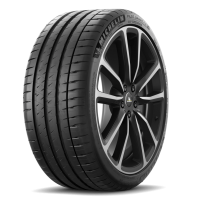
Michelin Pilot Sport 5 Energy
255/45 R19 104Y XL
Category scores (% of best)
All discipline results (7)
Discipline positions compare the ranked tyres in this test, not the whole market. These are individual measurements, not weighted overall scores.
| Test | Position in discipline | Result | Gap to best |
|---|---|---|---|
| Dry BrakingLower is better | 1st / 4 | 34.1 m | Best in this discipline |
| Wet BrakingLower is better | 1st / 4 | 33.1 m | Best in this discipline |
| Wet Braking - WornLower is better | 1st / 4 | 47.5 m | Best in this discipline |
| Subj. Wet HandlingHigher is better | 1st / 4 | 8.17 Points | Best in this discipline |
| WearHigher is better | 1st / 4 | 31700 KM | Best in this discipline |
| Rolling ResistanceLower is better | 4th / 4 | 6.4 kg/t | +0.80 kg/t |
| AbrasionLower is better | 1st / 4 | 1184 g | Best in this discipline |
Pirelli P Zero PZ4 T0
255/45 R19 104Y XL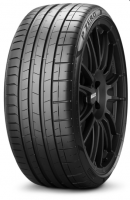
Category scores (% of best)
All discipline results (7)
Discipline positions compare the ranked tyres in this test, not the whole market. These are individual measurements, not weighted overall scores.
| Test | Position in discipline | Result | Gap to best |
|---|---|---|---|
| Dry BrakingLower is better | 3rd / 4 | 36 m | +1.90 m |
| Wet BrakingLower is better | 2nd / 4 | 38.2 m | +5.10 m |
| Wet Braking - WornLower is better | 3rd / 4 | 48.9 m | +1.40 m |
| Subj. Wet HandlingHigher is better | 2nd / 4 | 7.08 Points | -1.09 Points |
| WearHigher is better | 2nd / 4 | 31500 KM | -200.00 KM |
| Rolling ResistanceLower is better | 3rd / 4 | 6.3 kg/t | +0.70 kg/t |
| AbrasionLower is better | 2nd / 4 | 1215 g | +31.00 g |
Hankook Ventus S1 evo 3 ev T2
255/45 R19 104W XL
Category scores (% of best)
All discipline results (7)
Discipline positions compare the ranked tyres in this test, not the whole market. These are individual measurements, not weighted overall scores.
| Test | Position in discipline | Result | Gap to best |
|---|---|---|---|
| Dry BrakingLower is better | 3rd / 4 | 36 m | +1.90 m |
| Wet BrakingLower is better | 4th / 4 | 39.4 m | +6.30 m |
| Wet Braking - WornLower is better | 2nd / 4 | 47.7 m | +0.20 m |
| Subj. Wet HandlingHigher is better | 2nd / 4 | 7.08 Points | -1.09 Points |
| WearHigher is better | 3rd / 4 | 25600 KM | -6,100.00 KM |
| Rolling ResistanceLower is better | 2nd / 4 | 6 kg/t | +0.40 kg/t |
| AbrasionLower is better | 3rd / 4 | 1338 g | +154.00 g |
Continental SportContact 7 T0
255/45 R19 104Y XL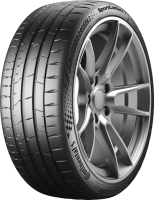
Category scores (% of best)
All discipline results (7)
Discipline positions compare the ranked tyres in this test, not the whole market. These are individual measurements, not weighted overall scores.
| Test | Position in discipline | Result | Gap to best |
|---|---|---|---|
| Dry BrakingLower is better | 2nd / 4 | 35.2 m | +1.10 m |
| Wet BrakingLower is better | 3rd / 4 | 38.9 m | +5.80 m |
| Wet Braking - WornLower is better | 4th / 4 | 50.6 m | +3.10 m |
| Subj. Wet HandlingHigher is better | 4th / 4 | 6.92 Points | -1.25 Points |
| WearHigher is better | 4th / 4 | 19300 KM | -12,400.00 KM |
| Rolling ResistanceLower is better | 1st / 4 | 5.6 kg/t | Best in this discipline |
| AbrasionLower is better | 4th / 4 | 1606 g | +422.00 g |
Discussion