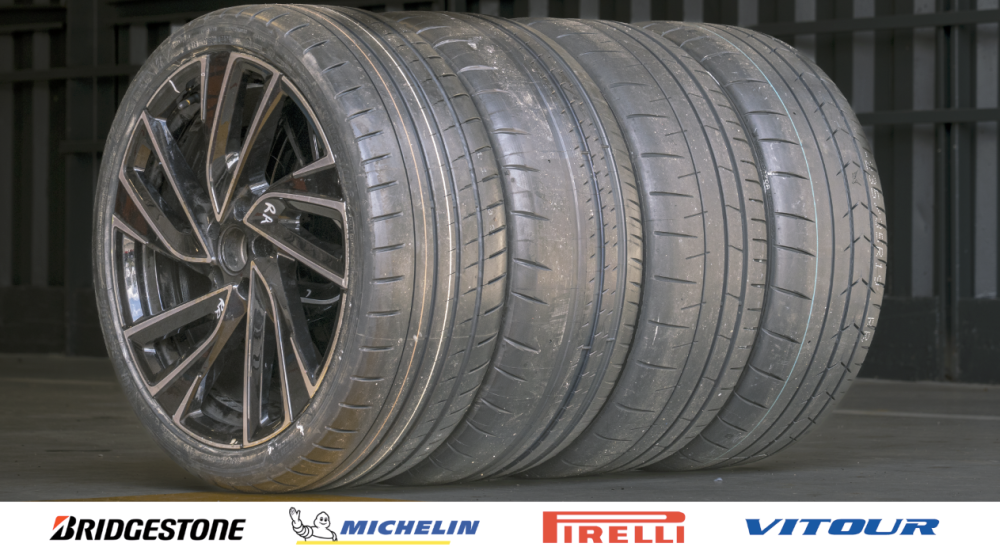
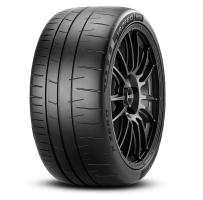
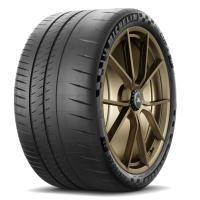
These four tyres might be the fastest track-focused, street-legal tyres you can buy in both Europe and North America right now. The Pirelli P Zero Trofeo RS, the Michelin Pilot Sport Cup 2 R, the Bridgestone Potenza Race, and the Vitour Tempesta P1 Plus - all tested on a VW Golf GTI Clubsport in 235/35 R19.
And it's not just a dry track test. I've tested wet handling, wet braking, aquaplaning, and rolling resistance too, because while yes, these tyres are built to go fast in the dry, some of you will be driving them on the road. Some of you will get caught in the rain on a track day. And I think that data matters.
Testing Methodology
Test Driver
Jonathan Benson
Tyre Size
235/35 R19
Test Vehicle
VW Golf GTI CS
Test Location
Professional Proving Ground
Tyre Pressures
2.5
Test Year
2025
Tyres Tested
4
Show full testing methodologyHide methodology
Every tyre is tested using calibrated instrumented measurement and structured subjective assessment. Reference tyres are retested throughout each session to correct for changing conditions, ensuring fair, repeatable comparisons. Multiple reference sets are used where needed so that control tyre wear does not affect accuracy.
We use professional-grade testing equipment including GPS data loggers, accelerometers, and calibrated microphones. All tyres are broken in and conditioned before testing begins. For full details on our equipment, preparation process, and calibration procedures, see our complete testing methodology.
Categories Tested
Dry Braking
For dry braking, I drive the test vehicle at an entry speed of 110 km/h and apply full braking effort to a standstill with ABS active on clean, dry asphalt. I typically use an 100–5 km/h measurement window. My standard programme is five runs per tyre set where possible, although the sequence can extend to as many as fifteen runs if conditions and tyre category justify it. I analyse the full set of runs and discard statistical outliers before averaging. Reference tyres are run repeatedly throughout the session to correct for changing conditions.
Dry Handling
For dry handling, I drive at the limit of adhesion around a dedicated handling circuit with ESC disabled where possible so I can assess the tyre's natural balance, transient response, and limit behaviour without electronic intervention masking the result. I usually complete between two and five timed laps per tyre set, depending on the circuit, tyre type, and consistency of conditions. I exclude laps affected by clear driver error or obvious environmental inconsistency. Control runs are carried out frequently throughout the session, and I often use multiple sets of control tyres so that wear on the references does not become a meaningful variable. For more track-focused products, I also do endurance testing, which is a set number of laps at race pace to determine tire wear patterns and heat resistance over longer driving.
Subj. Dry Handling
Objective data is only part of the picture, so I also carry out a structured subjective handling assessment at the limit of adhesion on a dedicated dry handling circuit. I score steering precision, steering response, turn-in behaviour, mid-corner balance, corner-exit traction, breakaway characteristics, and overall confidence using a standardised 1–10 scale used consistently across my testing. The final assessment combines numeric scoring with written technical commentary. I complete familiarisation laps on the control tyre before evaluating each candidate.
Wet Braking
For wet braking, I drive the test vehicle at an entry speed of 88 km/h and apply full braking effort to a standstill with ABS active on an asphalt surface with a controlled water film. I typically use an 80–5 km/h measurement window to isolate tyre performance from variability in the initial brake application. My standard programme is eight runs per tyre set where possible, although the sequence can extend to as many as fifteen runs if conditions and tyre category justify it. I analyse the full set of runs and discard statistical outliers before averaging. To correct for changing conditions, I run reference tyres repeatedly throughout the session — in wet testing, typically every three candidate test sets.
Wet Handling
For wet handling, I drive at the limit of adhesion around a dedicated handling circuit. I generally use specialist wet circuits with kerb-watering systems designed to maintain a consistent surface condition. ESC is disabled where possible so I can assess the tyre's natural balance, transient response, and limit behaviour without electronic intervention masking the result. I usually complete between two and five timed laps per tyre set, depending on the circuit, tyre type, and consistency of conditions. I exclude laps affected by clear driver error or obvious environmental inconsistency. Control runs are carried out frequently throughout the session, and I often use multiple sets of control tyres so that wear on the references does not become a meaningful variable.
Subj. Wet Handling
Objective data is only part of the picture, so I also carry out a structured subjective handling assessment at the limit of adhesion on a dedicated wet handling circuit. I score steering precision, steering response, turn-in behaviour, mid-corner balance, aquaplaning resistance, breakaway characteristics, and overall confidence using a standardised 1–10 scale used consistently across my testing. The final assessment combines numeric scoring with written technical commentary. I complete familiarisation laps on the control tyre before evaluating each candidate.
Straight Aqua
To measure straight-line aquaplaning resistance, I drive one side of the vehicle through a water trough of controlled depth, typically around 7 mm, while the opposite side remains on dry pavement. I enter at a fixed speed and then accelerate progressively. I define aquaplaning onset as the point at which the wheel travelling through the water exceeds a specified slip threshold relative to the dry-side reference wheel. I usually perform four runs per tyre set and average the valid results.
Rolling Resistance
Rolling resistance is measured under controlled laboratory conditions in accordance with ISO 28580 and UNECE Regulation 117 Annex 6. The tyre is mounted on a test wheel and loaded against a large-diameter steel drum. After thermal stabilisation at the prescribed test speed, rolling resistance force is measured at the spindle and corrected according to the relevant procedure. The result is expressed as rolling resistance coefficient, typically in kg/tonne.
How each category is weighted in the overall score:
Dry85%
Dry Braking20%
Dry Handling40%
Subj. Dry Handling40%
Wet10%
Wet Braking30%
Wet Handling30%
Subj. Wet Handling30%
Straight Aqua10%
Value5%
Rolling Resistance100%
Dry
This is what these tyres are all about. The dry is where they're supposed to shine, and there were some genuine surprises in the data - both in how close some tyres were and how far apart others ended up.
Dry Braking
The Pirelli Trofeo RS was shortest here at 32.33m, with the Vitour close behind at 32.93m. The Michelin was mid-pack at 33.43m. The real surprise is the Bridgestone Potenza Race at 35.78m - nearly 10% off the Pirelli, which is a bigger gap than I expected for a tyre in this category.
Dry Braking
Spread: 3.45 M (10.7%)|Avg: 33.62 M
Dry braking in meters (100 - 10 km/h) (Lower is better)
Dry Braking: Safety Impact: Best vs Worst Tyre
Dry Handling
The Pirelli was the clear standout, posting a 79.53s average - over 1.3 seconds faster than everything else. I had to recalibrate my braking points twice because the grip kept being more than I expected. There's a fast left-right chicane where every other tyre had me hesitating on turn-in, waiting for it to load up and grip - with the Trofeo RS I could flick it left, flick it right, stomp on the power and the tyre just gave me everything. It was the first tyre where I didn't feel like I was constantly managing understeer into corners. Behind it, the Vitour beat the Bridgestone and the Michelin. The Vitour's steering was crisp and it dug in well on turn-in, though I noticed more thermal degradation towards the end of its runs - its first lap was very quick but it dropped off significantly by the fourth, both in time and subjectively. The Michelin felt more connected to the road than its lap time suggests; the steering built up nicely, it was sharper mid-corner, and you could get on the power earlier than the Bridgestone. But it just didn't translate into faster times. The Bridgestone had a fun nonlinear steering ramp-up at sub-limit, but once you really pushed, it became the only tyre where I had trouble trail braking into corners - the construction felt a bit muddied at the very limit.
Dry Handling
Spread: 1.98 s (2.5%)|Avg: 80.81 s
Dry handling time in seconds (Lower is better)
Pirelli P Zero Trofeo RS
79.53 s
Vitour Tempesta P1 plus
80.84 s
Bridgestone Potenza Race
81.37 s
Michelin Pilot Sport Cup 2 R
81.51 s
Wet
Wet is not the design focus of these tyres, and I haven't weighted it heavily in the overall results. But I still think it's worth testing - this is data for the track day that gets rained on, or the driver running these as their daily on a fast car. Testing was done at around 18.5°C with a full warm-up lap to give the compounds a fair chance to build temperature.
Wet Braking
The Bridgestone Potenza Race was in a different league here - 27.95m, a full 5 metres shorter than the next best (Michelin at 33.04m). That's roughly 15% better, which is almost hard to believe. The Pirelli came in at 34.64m and the Vitour was weakest at 36.23m. If you're driving these on the road in the wet, the Bridgestone's stopping advantage is enormous.
Wet Braking
Spread: 8.28 M (29.6%)|Avg: 32.97 M
Wet braking in meters (80 - 10 km/h) (Lower is better)
Wet Braking: Safety Impact: Best vs Worst Tyre
Wet Handling
The Bridgestone was in a complete class of its own - 103.87s, nearly six seconds clear of the Pirelli in second (109.72s). The grip felt endless and the balance was an easy, safe understeer; every lap was within three tenths of each other, which is remarkable on a complicated wet circuit. It wasn't the sportiest feeling tyre on the front axle, with slightly dead steering around centre and a hint of delay in the front-rear phase, but the sheer confidence it gave you more than made up for it. The Pirelli placed second and had strong raw grip when the rubber was on the ground, but aquaplaning at the rear kept catching it out, making it more entertaining than you'd want on a wet track day. The Vitour (111.54s) and Michelin (111.67s) were essentially tied at the back on time. The Michelin was lovely to drive - the way the rear followed the front was beautiful, and it had real grip once it was warm - but it showed more run-to-run variability. The Vitour had the slowest warm-up of the group; its fronts didn't come alive until the end of the out-lap and the rears took even longer, which meant its earlier laps were noticeably slower. Once warm it was up there with the Michelin, but that warm-up penalty really hurt the average.
Wet Handling
Spread: 7.80 s (7.5%)|Avg: 109.20 s
Wet handling time in seconds [Average Temperature 18.5c] (Lower is better)
Bridgestone Potenza Race
103.87 s
Pirelli P Zero Trofeo RS
109.72 s
Vitour Tempesta P1 plus
111.54 s
Michelin Pilot Sport Cup 2 R
111.67 s
Straight Aquaplaning
My hunch during the wet handling laps was right - both the Pirelli and Vitour struggled here compared to the Michelin. The Cup 2 R floated at 73.4 km/h, just ahead of the Bridgestone at 73.1. The Pirelli was notably lower at 70.6 km/h, and the Vitour weakest at 69.1 km/h. That said, the differences were relatively small compared to the wet braking and handling gaps.
Straight Aqua
Spread: 4.30 Km/H (5.9%)|Avg: 71.55 Km/H
Float Speed in Km/H (Higher is better)
Michelin Pilot Sport Cup 2 R
73.40 Km/H
Bridgestone Potenza Race
73.10 Km/H
Pirelli P Zero Trofeo RS
70.60 Km/H
Vitour Tempesta P1 plus
69.10 Km/H
Value
Rolling Resistance
Nobody buys a track tyre for its fuel efficiency, but here's the data anyway - and it might matter if rolling resistance is eating into your top speed on a long straight. The Bridgestone was the most efficient at 8.9 kg/t, with the Michelin second at 9.4. The Pirelli was 9.9 and the Vitour was worst at 10.9 - around 22% higher than the Bridgestone, which is a sizeable gap.
Rolling Resistance
Spread: 2.00 kg / t (22.5%)|Avg: 9.78 kg / t
Rolling resistance in kg t (Lower is better)
Bridgestone Potenza Race
8.90 kg / t
Michelin Pilot Sport Cup 2 R
9.40 kg / t
Pirelli P Zero Trofeo RS
9.90 kg / t
Vitour Tempesta P1 plus
10.90 kg / t
19,000 km
£1.45/L
8.0 L/100km
--
Annual Difference
--
Lifetime Savings
--
Extra Fuel/Energy
--
Extra CO2
Estimates based on typical driving conditions. Rolling resistance accounts for approximately 20% of IC vehicle fuel consumption and 25% of EV energy consumption. Actual savings vary based on driving style, vehicle weight, road conditions, and tyre age. For comparative purposes only. Lifetime savings based on a 40,000km / 25,000 mile tread life.
Results
With a heavy dry weighting - because that's what these tyres are for - the Pirelli P Zero Trofeo RS won the test. Its WRC-derived compound and construction made it the fastest in dry braking, dry handling, and subjective feel, and it had the most stable thermal degradation of the group. The Michelin Cup 2 R finished second: not the fastest on stopwatch, but easy to drive, consistent, and with the best aquaplaning resistance. The Vitour Tempesta P1 Plus took third - a seriously strong result for a brand competing against premium giants, though watch the thermal degradation and wear on longer stints. The Bridgestone Potenza Race finished last on the dry-biased scoring, but don't let that fool you - in the wet it was untouchable, and if you want a very fast tyre you can also use every day in the rain, nothing here comes close to it. None of these are bad tyres; it just depends on what you need from them.
Best in test for dry performance, with the quickest lap time, strongest braking, highest subjective dry score and most consistent pace.
In the wet it felt like a proper track tyre, with less stability and aquaplaning resistance than the best options here.
The Pirelli P Zero Trofeo RS finished 1st overall in my test, and it did that by being the clear leader in the dry. It was best in dry braking, but most importantly the fastest and most consistent on track.
In the wet it sat in the lower half of the group for braking and aquaplaning speed, and it didn't have the same rear-axle confidence as the best wet tyre. Rolling resistance was also on the higher side compared with the top performers, so it's a very dry-focused choice.
Good subjective feel in the dry, easy to drive, and best aquaplaning resistance.
Higher wear than average on outside front, not the fastest anymore.
The Michelin Pilot Sport Cup 2 R finished 2nd overall. In the dry it was towards the back on the stopwatch, but it still scored 2nd in subjective dry handling, so it felt better than the lap time suggests. In the wet it was mixed: straight-line aquaplaning speed was 2nd, but it was 4th in wet handling and only 3rd in wet braking, and the subjective wet score was also in the lower half. Rolling resistance was fine, not that it matters.
Quick dry lap time with strong dry braking, good subjective handling in the dry and well priced.
Weaker in wet and highrolling resistance, doesn't really like getting too hot.
The Vitour Tempesta P1 was competitive on pace, tying for 2nd in dry handling and taking 2nd in dry braking, with a strong subjective dry score as well. The problems were in the wet, where it was 4th in wet braking, 4th in wet handling, 4th in subjective wet handling, and also last in straight-line aquaplaning speed. It also had the highest rolling resistance. I feel this tyre is best suited to short stints such as autocross rather than long sessions on track.
Best in test in the wet and also the most efficient on rolling resistance, making it the easiest to live with outside of the track.
Dry braking and subjective dry feel were both at the back. Fast first lap on track but then dropped time.
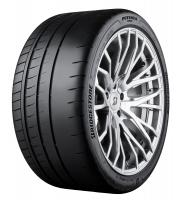
The Bridgestone Potenza Race was the clear leader in wet performance. It was best in wet braking, best in wet handling, which matched what I felt in the car with much better stability and confidence than most of the other track tyres. It also had the best rolling resistance result. The compromise was on dry performance, where it was last in dry braking and weaker than the fastest in dry handling, with very quick thermal degradation and non-linear steering.




Discussion