
| Test Summary | |
| Wet Braking |
Michelin Pilot Sport 4 S |
| Dry Braking |
Continental ExtremeContact Sport |
| Noise |
Pirelli P Zero PZ4 |
| Snow Handling |
Michelin Pilot Sport 4 S |
| Snow Handling |
Michelin Pilot Sport 4 S |
| Ice Braking |
Pirelli P Zero PZ4 Hankook Ventus V12 evo2 |
The biggest surprise of the test? The fact the Michelin Pilot Sport 4 S is available in 18" sizes in America, but only 19" and above in Europe. Another idiosyncrasy of an American market test is the Continental ExtremeContact range, which isn't available in Europe, but fairly safe to assume the tyre on test here is broadly similar to the Continental Sport Contact 6.
Dry
In the dry the Michelin dominated, winning the dry handling tests by an impressive margin and finishing joint first under dry braking. The Michelin had the best steering feel and balance in the test, which allowed the tester to push harder with more confidence.
Wet
In the wet the balance between the Continental and Michelin was reversed, with the German tyre manufacturer taking a big win under wet braking and holding onto that advantage during the wet circle test. As in the dry testing, the subjective confidence of the Continental in the wet earned it first place, rather than outright grip.
The Hankook was the quietest tyre on test, but the margin between the top three tyres was only one dB
Results

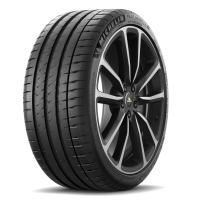
In driving, speed usually grows as confidence grows, and this Michelin exemplifies that idea. The Pilot Sport 4 S assures the driver with its tenacious grip, stellar lateral stiffness, and progressive at-the-limit behavior. It is easy and rewarding to drive aggressively, and it allows the driver to return to full throttle earlier than any other tire in this test.
Out in the real world, the Michelin demonstrated a subtle tendency to follow grooves in the road. Otherwise, the Pilot Sport 4 S is as docile in traffic as it is around a racetrack, never hammering down imperfections nor singing on the smooth stuff.
As with the Pilot Super Sport, Michelin is likely to be faced with so many automakers eager to fit the 4 S to their sports cars that it will turn customers away. Fortunately, you don’t need Michelin’s approval to fit your car with Pilot Sport 4 S tires.
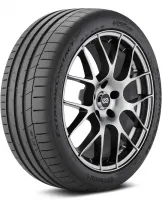
The ExtremeContact Sport locked in second place with a solid performance in the dry, although not exactly threatening the Michelin. It delivers sharp steering precision that makes it feel alert and responsive when driven casually, but that quality fades when pushed past the limit in the dry.
Our ears registered louder thwacks compared with the competitors over the same cracks and expansion joints on-road—similar to the almost metallic clank of a bouncing basketball. But that’s a small price to pay for exceptional wet grip and impressive dry performance. Plus, Continental asks only $164 for the ExtremeContact Sport, $34 less than our winner.
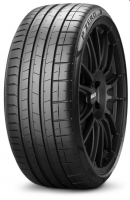
Even a driver of Geswein’s caliber can’t make the P Zero more than a midpack performer in the wet, as the Pirelli’s grip takes a big hit when the water flows. The P Zero used 109 feet of pavement to stop from 50 mph in the wet, 14 feet more than the best-in-test Continental. The Pirelli also tied the Goodyear for the lowest lateral grip in the wet at 0.75 g.
But it does offer commendable compliance on the road, and at $153 apiece, it’s the cheapest tire here. When we look at the test results, though, there’s a clear dividing line separating the top tier from the rest of the class. The Pirelli is on the wrong side of it.
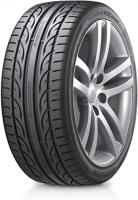
In other categories, the Hankook impresses less. The Ventus V12 Evo2 is laterally soft when loaded up in a corner, and steering inputs are imprecise. On wet surfaces, its favorable progressivism dries up. It also emits tones that penetrate the cabin, with a high-pitched zip as it rolls and loud thumps over imperfections.
And while easy to drive, the Hankook's performances in both dry and wet tests were only marginally better than those of the Goodyear. Its fourth-place position was cemented by this objective performance that placed it in, well, fourth place.
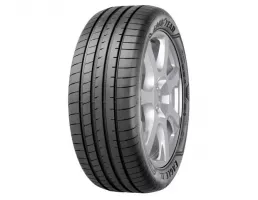
It also wilts under subjective scrutiny, lacking high lateral firmness, the ability to impart steering feel, and the progressive rise and fall of adhesion as you approach and exceed its ultimate grip. Geswein noted that “excursions beyond the limit kill lap times,†as grip is slow to return once the tire starts to slide.
Even on our road drive, when our butts and ears were tuned to observe ride quality and road noise, we couldn’t help but notice that the Goodyear Eagle F1 Asymmetric 3 was unsettled by midcorner bumps in ways the other tires weren’t. Goodyear’s tire does deliver less ride harshness than both the Hankook and Continental tires, and road noise is nicely managed, but neither of those qualities is what makes a summer performÂance tire great.
Hello, subtotals are mistaken w.r. to source: https://www.caranddriver.co...
You can buy 17" MP4S in the US as well, surprise surprise ;)
I think you mean idiosyncrasy not idiocy, which would be not very nice! :) Indeed it would be very interesting to know, truly, how the Pilot Sport 4 and 4S and how the ContiSportContact 6, PremiumContact6 and ExtremeContact Sport compare. In the US market, the ExtremeContact 6 is around 50% cheaper than the Pilot Sport 4S, and if it truly performs closely (as seems to be the case), it's very attractive indeed.
Good point thank you :)
As mentioned I can't speak for the American market, but in Europe the Michelin Pilot Sport 4 S and the Continental Sport Contact 6 perform very closely, but the Michelin has an advantage with wear.