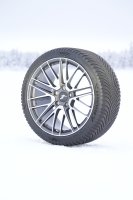
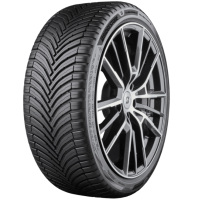
Below is the data from TUV report 713349044-PM which was created independantly at the request of Goodyear to benchmark their new tyre, the Goodyear Vector All Season 4.
It's important to note that TUV only provides data in terms of percentages, so we have recalculated this based on averages for the test criteria. The distances and times below are not literal; they are all based on calculated averages and the percentage is provided by TUV. The gaps between the tyres is accurate.
We have also applied our own score weighting to the final results, which you can see on the results table page to make it fall in line more with how a Tyre Reviews test is scored.
Now we have said all that, it looks like it is a strong start for the new Goodyear Vector All Season 4!
Dry
The Pirelli Cinturato All Season SF3 stopped shortest, ahead of the Continental and Michelin which were within a tenth of a metre of each other. The new Goodyear and Bridgestone tied at the back of the field, though the gap from first to last was small.
Dry Braking
Spread: 1.32 M (3.4%)|Avg: 39.65 M
Dry braking in meters (Lower is better)
Dry Braking: Safety Impact: Best vs Worst Tyre
The Goodyear Vector All Season 4 led the dry handling test, with the Continental, Pirelli and Michelin all finishing within half a second of each other. The Bridgestone was the slowest around the 3080 metre circuit.
Dry Handling
Spread: 2.73 s (3.4%)|Avg: 81.26 s
Dry handling time in seconds (Lower is better)
Goodyear Vector All Season 4
80.00 s
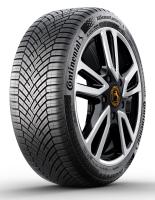
Continental AllSeasonContact 2
80.89 s
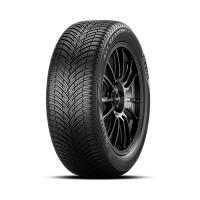
Pirelli Cinturato All Season SF3
81.22 s
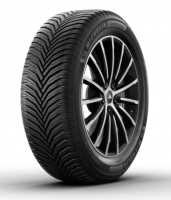
Michelin CrossClimate 2
81.47 s
Bridgestone Turanza All Season 6
82.73 s
Wet
The Goodyear took the win in wet braking, with the Continental and Pirelli effectively tied for second. The Michelin was the weakest performer here, stopping 2.5 metres later than the Goodyear.
Wet Braking
Spread: 2.51 M (7.2%)|Avg: 35.86 M
Wet braking in meters (Lower is better)
Wet Braking: Safety Impact: Best vs Worst Tyre
The low grip surface produced the largest spread of any wet test, with 7.6 metres separating the Goodyear from the Bridgestone. The Continental and Pirelli held second and third, while the Michelin and Bridgestone struggled most when grip levels dropped.
Spread: 7.57 M (16.8%)|Avg: 49.70 M
(Lower is better)
Wet Braking - Low Grip: Safety Impact: Best vs Worst Tyre
The Goodyear was fastest around the wet handling circuit, with the Pirelli closest behind. The Michelin's strong snow performance did not carry over here, finishing slowest along with the Bridgestone.
Wet Handling
Spread: 6.01 s (7.1%)|Avg: 88.47 s
Wet handling time in seconds (Lower is better)
Goodyear Vector All Season 4
85.00 s
Pirelli Cinturato All Season SF3
87.09 s
Continental AllSeasonContact 2
88.91 s
Bridgestone Turanza All Season 6
90.33 s
Michelin CrossClimate 2
91.01 s
The Michelin and Pirelli resisted aquaplaning best, both clearing 88 km/h before losing contact with the road.
Straight Aqua
Spread: 5.33 Km/H (6%)|Avg: 86.29 Km/H
Float Speed in Km/H (Higher is better)
Michelin CrossClimate 2
88.58 Km/H
Pirelli Cinturato All Season SF3
87.98 Km/H
Goodyear Vector All Season 4
86.00 Km/H
Bridgestone Turanza All Season 6
85.66 Km/H
Continental AllSeasonContact 2
83.25 Km/H
Snow
The Michelin CrossClimate 2 stopped shortest on snow, with the Goodyear next and the rest of the field grouped very closely.
Snow Braking
Spread: 0.91 M (5.3%)|Avg: 17.83 M
Snow braking in meters (Lower is better)
Snow Braking: Safety Impact: Best vs Worst Tyre
The Michelin again led on snow traction. The Bridgestone was slowest off the line.
Snow Traction
Spread: 0.32 s (11.1%)|Avg: 3.06 s
Snow acceleration time (Lower is better)
Michelin CrossClimate 2
2.87 s
Goodyear Vector All Season 4
3.00 s
Continental AllSeasonContact 2
3.09 s
Pirelli Cinturato All Season SF3
3.15 s
Bridgestone Turanza All Season 6
3.19 s
The Michelin was fastest around the snow handling circuit, continuing its strong winter performance. The Goodyear took second, and the Bridgestone was again the slowest of the group.
Snow Handling
Spread: 8.06 s (10.3%)|Avg: 82.27 s
Snow handling time in seconds (Lower is better)
Michelin CrossClimate 2
78.05 s
Goodyear Vector All Season 4
80.00 s
Continental AllSeasonContact 2
82.73 s
Pirelli Cinturato All Season SF3
84.48 s
Bridgestone Turanza All Season 6
86.11 s
Value
The Michelin had the lowest rolling resistance, followed by the Continental and Goodyear which were close together. The Pirelli was the least efficient by a clear margin, with the Bridgestone not far behind it.
Rolling Resistance
Spread: 1.90 kg / t (26.8%)|Avg: 7.89 kg / t
Rolling resistance in kg t (Lower is better)
Michelin CrossClimate 2
7.10 kg / t
Continental AllSeasonContact 2
7.40 kg / t
Goodyear Vector All Season 4
7.50 kg / t
Bridgestone Turanza All Season 6
8.44 kg / t
Pirelli Cinturato All Season SF3
9.00 kg / t
19,000 km
£1.45/L
8.0 L/100km
--
Annual Difference
--
Lifetime Savings
--
Extra Fuel/Energy
--
Extra CO2
Estimates based on typical driving conditions. Rolling resistance accounts for approximately 20% of IC vehicle fuel consumption and 25% of EV energy consumption. Actual savings vary based on driving style, vehicle weight, road conditions, and tyre age. For comparative purposes only. Lifetime savings based on a 40,000km / 25,000 mile tread life.
Results
The Goodyear Vector All Season 4 took the overall win on the strength of its wet performance, with the Michelin CrossClimate 2 leading the snow tests but giving up ground in the wet, and the Bridgestone Turanza All Season 6 finishing last after weak results across most categories.



Discussion