Every tyre is tested using calibrated instrumented measurement and structured subjective assessment. Reference tyres are retested throughout each session to correct for changing conditions, ensuring fair, repeatable comparisons. Multiple reference sets are used where needed so that control tyre wear does not affect accuracy.
We use professional-grade testing equipment including GPS data loggers, accelerometers, and calibrated microphones. All tyres are broken in and conditioned before testing begins. For full details on our equipment, preparation process, and calibration procedures, see our complete testing methodology.
Categories Tested
Dry Braking
For dry braking, I drive the test vehicle at an entry speed of 110 km/h and apply full braking effort to a standstill with ABS active on clean, dry asphalt. I typically use an 100–5 km/h measurement window. My standard programme is five runs per tyre set where possible, although the sequence can extend to as many as fifteen runs if conditions and tyre category justify it. I analyse the full set of runs and discard statistical outliers before averaging. Reference tyres are run repeatedly throughout the session to correct for changing conditions.
Dry Handling
For dry handling, I drive at the limit of adhesion around a dedicated handling circuit with ESC disabled where possible so I can assess the tyre's natural balance, transient response, and limit behaviour without electronic intervention masking the result. I usually complete between two and five timed laps per tyre set, depending on the circuit, tyre type, and consistency of conditions. I exclude laps affected by clear driver error or obvious environmental inconsistency. Control runs are carried out frequently throughout the session, and I often use multiple sets of control tyres so that wear on the references does not become a meaningful variable. For more track-focused products, I also do endurance testing, which is a set number of laps at race pace to determine tire wear patterns and heat resistance over longer driving.
Wet Braking
For wet braking, I drive the test vehicle at an entry speed of 88 km/h and apply full braking effort to a standstill with ABS active on an asphalt surface with a controlled water film. I typically use an 80–5 km/h measurement window to isolate tyre performance from variability in the initial brake application. My standard programme is eight runs per tyre set where possible, although the sequence can extend to as many as fifteen runs if conditions and tyre category justify it. I analyse the full set of runs and discard statistical outliers before averaging. To correct for changing conditions, I run reference tyres repeatedly throughout the session — in wet testing, typically every three candidate test sets.
Wet Handling
For wet handling, I drive at the limit of adhesion around a dedicated handling circuit. I generally use specialist wet circuits with kerb-watering systems designed to maintain a consistent surface condition. ESC is disabled where possible so I can assess the tyre's natural balance, transient response, and limit behaviour without electronic intervention masking the result. I usually complete between two and five timed laps per tyre set, depending on the circuit, tyre type, and consistency of conditions. I exclude laps affected by clear driver error or obvious environmental inconsistency. Control runs are carried out frequently throughout the session, and I often use multiple sets of control tyres so that wear on the references does not become a meaningful variable.
Snow Handling
For snow handling, I drive at the limit of adhesion around a dedicated snow handling circuit with ESC disabled where possible. The circuit is groomed and prepared after every run while tyres are being changed, so each set runs on a consistently prepared surface. I usually complete between two and five timed laps per tyre set, excluding laps affected by clear driver error or obvious environmental inconsistency. Because snow surfaces degrade more rapidly than asphalt, control runs are carried out more frequently — typically every two candidate test sets.
Fuel Consumption
For real-world fuel consumption testing, I use matched vehicles on the same route under stabilised conditions, comparing candidate tyres with reference tyres. When an oval is not used, fuel use is measured over repeated runs in both directions to minimise the influence of wind and gradient. The result is reported in litres per 100 km, and the difference in consumption between candidate and reference is attributed to the difference in rolling resistance.
How each category is weighted in the overall score:
Dry28%
Dry Braking50%
Dry Handling50%
Wet39%
Wet Braking50%
Wet Handling50%
Snow22%
Snow Handling100%
Value11%
Fuel Consumption100%
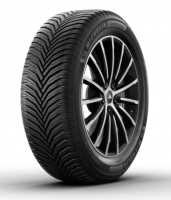
The Michelin CrossClimate 2 has finally been launched in Europe, and Tyre Reviews has the exclusive first test comparing the new Michelin CrossClimate 2 to the outgoing Michelin CrossClimate+.
In this test we look at the improvements made in dry grip, including dry braking which was already very impressive, the step forward in wet grip and aquaplaning resistance, the huge improvement in rolling resistance meaning lower fuel consumption / better MPG for your car, and the serious step forward Michelin have made in the snow performance of the new tyre.
Watch the video to see how the new Michelin CrossClimate 2 is better than the Michelin CrossClimate+ in nearly every way!
Dry
Dry Braking
Spread: 1.81 M (5.3%)|Avg: 35.06 M
Dry braking in meters (60 - 3 MPH) (Lower is better)
Dry Braking: Safety Impact: Best vs Worst Tyre
Dry Handling
Spread: 1.74 s (2.2%)|Avg: 81.30 s
Dry handling time in seconds (Lower is better)
Michelin CrossClimate 2
80.43 s
Michelin CrossClimate Plus
82.17 s
Wet
Wet Braking
Spread: 1.43 M (4.9%)|Avg: 29.92 M
Wet braking in meters (50 - 5 MPH) (Lower is better)
Wet Braking: Safety Impact: Best vs Worst Tyre
Wet Handling
Spread: 0.03 s (0.1%)|Avg: 49.02 s
Wet handling time in seconds (Lower is better)
Michelin CrossClimate 2
49.00 s
Michelin CrossClimate Plus
49.03 s
Snow
Snow Handling
Spread: 2.70 s (3%)|Avg: 92.65 s
Snow handling time in seconds (Lower is better)
Michelin CrossClimate 2
91.30 s
Michelin CrossClimate Plus
94.00 s
Environment
Fuel Consumption
Spread: 0.11 l/100km (2%)|Avg: 5.61 l/100km
Fuel consumption in Litres per 100 km (Lower is better)
Michelin CrossClimate 2
5.55 l/100km
Michelin CrossClimate Plus
5.66 l/100km
19,000 km
£1.45/L
8.0 L/100km
--
Annual Difference
--
Lifetime Savings
--
Extra Fuel/Energy
--
Extra CO2
Estimates based on typical driving conditions. Rolling resistance accounts for approximately 20% of IC vehicle fuel consumption and 25% of EV energy consumption. Actual savings vary based on driving style, vehicle weight, road conditions, and tyre age. For comparative purposes only. Lifetime savings based on a 40,000km / 25,000 mile tread life.
The Michelin CrossClimate 2 is a worthy upgrade on the original CrossClimate+. It improves the outgoing tyres grip in nearly all conditions, it makes a significant step forward in the snow, and has significantly lower rolling resistance.
All in all, the CrossClimate 2 is a very impressive all season tyre.
The Michelin CrossClimate+ has been testing well since 2017, rarely finishing out of the top five, even in 2020. The replacement Michelin CrossClimate 2 was launched in September 2021, and improves on the CrossClimate plus in the dry, wet, snow and rolling resistance.
I have CrossClimate's front and back on my Mitsubishi Outlander PHEV but the front drivers tyre has got it's second puncture since August 2022. They don't seem to do well on stones (lots of driveways where I live have stones). Today the garage replaced the front drivers side tyre with a CrossClimate 2 (I asked for CrossClimate and didn't notice until I got home). Will this be a problem?
The tyres should have similar dry and wet performances but the CC2 has a softer sidewall and has much more snow performance so ideally I would want the tyres to match across the axle, and have the newer pair on the rear axle.
Hi Tyre reviews, after watching Johnathan's video on winter tires guide. I am planning to buy a set of CC2 for my 22 BRZ as winter tires. I live in Seattle where we have a mild winter with little snow but we do have lots of inclines. Does the CC2 has adequate winter performance for a RWD car to climbi snowy hills?
I have CC+ on all 3 cars in our household. My wife's has 2 on the front (FWD Focus) and am now putting CC2 on rear pair (non-CC pair) that now need replacing (with a rotation to put the fresh ones on the driven wheels). The CC+ have done 30k miles on the front with 3mm+ tread remaining! On my car the first pair have done 25k miles with 4mm+ tread remaining after one rotation (well front to back and vice-versa given they are directional). The CC2 review looks really great and I hope to get similar miles out of them too. I do not remember the last pair of tyres that gave me >20k miles - I'm sold! :)
I need to change my summers and CC have always in the past suited very well.
Current car I can get CC+ front and rear, but only CC2 for the fronts. I know conventional wisdom says not to mix, but would it be unadvisable to have CC2 on the front (225/40/19) and CC+ on the rear (255/35/19)? Ask because the tyres seem quite similar, though guess appearances can be deceiving.
It's not an ideal situation, though I'm sure people have mixed worse. The biggest issue would be on snow, where you'd have more grip at the front than rear which could cause oversteer. Does your car handbook have an allowable winter tyre size with the same size front and rear?
Seem that 225/45/18 are offered as a square set up. But another set of rims = ££££.
Noted the potential re snow/oversteer. So think that prob the biggest (and maybe only) downside, not that we have too much here on the south coast, and I always have chains with me (as I do go to the Alps)!! Something to mull over - either wait and see if Mich bring out more sizes (will they?), or mix or go CC+ all round.
If your using CC2's as winter tires, what's the minimum recommended thread before you should change them? 5/32? Or 6/32? When does the snow performance tank?
Michelin make their tires work better than most when worn, however the performance does drop off below 3mm and that's where they stop being legal winter tires in many European countries
3mm seems really low for a winter use tire. My understanding was around 5/32 ( 4mm ) is generally where you lose snow performance. Do you think CC2 can really give you decent snow performance that low? It does pose an interesting conundrum, If the michelins can give better performance when worn. Then calculating value the way autobild does it based on wear seems incomplete. As it does not capture the low wear performance, which adds to the value proposition of Michelin tires
You're right performance does start to drop off at 4mm, there's a few countries that mandate that, but most countries and winter tyres with "snow wear" indicators have it set at 3mm, which seems like a nice balance to me too.
Hello, What would you pick for a megane mk 3 ST (1.5 110bhp) the Goodyear F1 AS5 in 205/50R17 or in 225/45/R17? I can fit both, the 225's are about 75€ each while the 205's are 110€. Huge price gap considering changing 4. But i'm worried about increased hydroplaning and fuel consuption. Do you think these diferences will be noticeable or they will be so marginal I should just save the money for a better car. Thanks in advance
Although I partly agree with a statement "go with factory recommended", today the factories can recommend what is for them the best (typically quite unique and expensive tyre sizes). Personally I don't see a reason, why a compact car should go for a broad and huge tyre 225/45/R17, unless the owner prefers such a sportive look. Standard (and the best price too!) for many, many years is here 205/55 R16, so if you insist on 17'...then 205/50 R17 suffice, which will have reasonably lower consumption (and aquaplaning only by higher speed and more rubber thickness means better comfort) during their lifecycle (average 40 000 km), that they will pay off themselves, in compare to 225 size (more heavy)...especially if you have just 110 bhps, and not some sharp Trophy version.
Thanks for the replies. In this case both sizes are factory certified for 17 inch wheels. It came fitted with the 205's with the 17" wheels. Getting new wheels is not and option as a set of 4 original alloys goes for about 700€ used in my area. The price difference made me wonder about the 225's but the fuel consumption and aquaplaning performance made me wonder.
experience so far ____ cc+, 3 years and 34000km... 4+mm left it can be loud and harsh in cold temp. it can skid in wet autumn or summer.. arrgh ! i had problems on ice. i´m leaning towards vector-as-g3, i hope there are no bad surprises..
Hello, when can we expect an all-season tire test? I was almost decided on the Continental All Season Contact due to the fact that they are the most versatile in the tests, the CC + seemed too weak in the snow. But maybe CC2 will be better than Continental? Could you please reveal how the Continental fared compared to the CC2? :)
Hmm was hoping to replace my CC+ SUV, which are pretty much worn out after around 30k miles, but CC2 don't yet come as SUV, or in my size 255/45 R20. Any ideas when this may be released, I'd hate to fork out for a full set of CC+ the day before I could get CC2, especially after watching the review.
It appears Michelin are making 107 sizes, but don’t make 215/45 R18 as fitted as standard size to Seat Arona, Skoda Kamiq, VW T-cross etc which means although I would like it, it is not available.
The Cross Climate 2 seems perfect for UK (much more sensible than summer tyres fitted to new cars), but I don’t get why they want to exclude UK spec cars from it being available, anyone know?
Thanks for excellent reviews, looking forward to all season comparisons
Have a look in your car's homologation certificate, where are surely written alternative tire sizes. There is a higher chance to match with available market offer.
I've been anticipating the CC2 arriving in Europe. I've got the CC+ and they are excellent on our VW Touran, but are now about half worn at 12,000 miles (although I've swapped the fronts with the rears so should be able to to maximise the mileage until they are all at 2-2.5mm depth, when I will replace them).
I will definitely be seriously considering these in a year's time, hopefully availability will be good then and some deals can be had to help with the initial outlay.
Awesome! Now waiting for your already announced test. I wonder how these perform compared to Goodyear's V4S 3rd :)
For my primary car I'd take those now, looking at how little mileage I do per year recently. More with company car or rentals. Private car... I replace the tyres when they still have about 5-6 mm tread, but already are 5 (winter) - 8 (summer, if nothing wrong earlier) years old. So all seasons would be good here. If not for the 2 sets of rims, I'd be running of all seasons since I got this car ;) Next one and second in the family will definitely get proper all-seasons, if usage scenario and road conditions won't change in the near future :)
I've seen your great review of CS+ vs CS2, I've had several CS+ on my car for three years now, I change them every 50,000 kms approx. I live in the North of Spain. I have to change the rear shortly and I had clear to change to Goodyear Vector 4seasons gen-3 but it is better to change to CS2? What is your opinion please.
The CS+ rear are noisy, I have a Peugeot 308SW, maybe not as soundproof as your Golf 8 and I wanted to try the Good ones but after seeing your video I have doubts.
Given the semi unique nature of the CC, I would certainly prefer to swap a CC+ with a CC2. The CC2 has very low noise according to my test this year (out soon) so that should be suitable
Ok thanks, your answer makes my decision to delay until your review, I was almost convinced to change to Goodyear because the noise in the back I think is caused by the CC+ and not by some mechanical problem. I will wait nervously.


I have CrossClimate's front and back on my Mitsubishi Outlander PHEV but the front drivers tyre has got it's second puncture since August 2022. They don't seem to do well on stones (lots of driveways where I live have stones). Today the garage replaced the front drivers side tyre with a CrossClimate 2 (I asked for CrossClimate and didn't notice until I got home). Will this be a problem?
The tyres should have similar dry and wet performances but the CC2 has a softer sidewall and has much more snow performance so ideally I would want the tyres to match across the axle, and have the newer pair on the rear axle.
Hi Tyre reviews, after watching Johnathan's video on winter tires guide. I am planning to buy a set of CC2 for my 22 BRZ as winter tires. I live in Seattle where we have a mild winter with little snow but we do have lots of inclines. Does the CC2 has adequate winter performance for a RWD car to climbi snowy hills?
It sure does, it outperforms some winter tyres in the snow!
I have CC2’s on my wife’s car and they are great. Having lived in Germany and Europe I would not be with out them. Highly recommend.
I have CC+ on all 3 cars in our household. My wife's has 2 on the front (FWD Focus) and am now putting CC2 on rear pair (non-CC pair) that now need replacing (with a rotation to put the fresh ones on the driven wheels). The CC+ have done 30k miles on the front with 3mm+ tread remaining! On my car the first pair have done 25k miles with 4mm+ tread remaining after one rotation (well front to back and vice-versa given they are directional). The CC2 review looks really great and I hope to get similar miles out of them too. I do not remember the last pair of tyres that gave me >20k miles - I'm sold! :)
Glad you're enjoying them, if you're not already feel free to put a review on the site :)
I need to change my summers and CC have always in the past suited very well.
Current car I can get CC+ front and rear, but only CC2 for the fronts. I know conventional wisdom says not to mix, but would it be unadvisable to have CC2 on the front (225/40/19) and CC+ on the rear (255/35/19)? Ask because the tyres seem quite similar, though guess appearances can be deceiving.
It's not an ideal situation, though I'm sure people have mixed worse. The biggest issue would be on snow, where you'd have more grip at the front than rear which could cause oversteer. Does your car handbook have an allowable winter tyre size with the same size front and rear?
Seem that 225/45/18 are offered as a square set up. But another set of rims = ££££.
Noted the potential re snow/oversteer. So think that prob the biggest (and maybe only) downside, not that we have too much here on the south coast, and I always have chains with me (as I do go to the Alps)!! Something to mull over - either wait and see if Mich bring out more sizes (will they?), or mix or go CC+ all round.
There's certainly more CC2 sizes due next year, there's a full list of this years sizes on the site
If your using CC2's as winter tires, what's the minimum recommended thread before you should change them? 5/32? Or 6/32? When does the snow performance tank?
Michelin make their tires work better than most when worn, however the performance does drop off below 3mm and that's where they stop being legal winter tires in many European countries
3mm seems really low for a winter use tire. My understanding was around 5/32 ( 4mm ) is generally where you lose snow performance. Do you think CC2 can really give you decent snow performance that low? It does pose an interesting conundrum, If the michelins can give better performance when worn. Then calculating value the way autobild does it based on wear seems incomplete. As it does not capture the low wear performance, which adds to the value proposition of Michelin tires
You're right performance does start to drop off at 4mm, there's a few countries that mandate that, but most countries and winter tyres with "snow wear" indicators have it set at 3mm, which seems like a nice balance to me too.
Hello, What would you pick for a megane mk 3 ST (1.5 110bhp) the Goodyear F1 AS5 in 205/50R17 or in 225/45/R17?
I can fit both, the 225's are about 75€ each while the 205's are 110€. Huge price gap considering changing 4. But i'm worried about increased hydroplaning and fuel consuption. Do you think these diferences will be noticeable or they will be so marginal I should just save the money for a better car.
Thanks in advance
I can only recommend sticking with what the factory recommends, though the differences between the two sizes wouldn't be huge
Although I partly agree with a statement "go with factory recommended", today the factories can recommend what is for them the best (typically quite unique and expensive tyre sizes).
Personally I don't see a reason, why a compact car should go for a broad and huge tyre 225/45/R17, unless the owner prefers such a sportive look.
Standard (and the best price too!) for many, many years is here 205/55 R16, so if you insist on 17'...then 205/50 R17 suffice, which will have reasonably lower consumption (and aquaplaning only by higher speed and more rubber thickness means better comfort) during their lifecycle (average 40 000 km), that they will pay off themselves, in compare to 225 size (more heavy)...especially if you have just 110 bhps, and not some sharp Trophy version.
Thanks for the replies. In this case both sizes are factory certified for 17 inch wheels. It came fitted with the 205's with the 17" wheels. Getting new wheels is not and option as a set of 4 original alloys goes for about 700€ used in my area. The price difference made me wonder about the 225's but the fuel consumption and aquaplaning performance made me wonder.
experience so far ____ cc+, 3 years and 34000km... 4+mm left
it can be loud and harsh in cold temp. it can skid in wet autumn or summer.. arrgh !
i had problems on ice.
i´m leaning towards vector-as-g3, i hope there are no bad surprises..
All all season tyres will have problems on ice sadly! Sounds like you need a full winter!
I have found the continental allseasoncontact to be much better in the wet than the cc and cc+. I have used all three but not the cc2.
That matches the data from last years test :) https://www.tyrereviews.com...
This year it's a little different, test out Monday
i heard conti can wear quickly ?
Nope, in fact in the CC2 launch Michelin showed data with the Conti actually getting a tiny bit more mileage than the CC2
Hello, when can we expect an all-season tire test? I was almost decided on the Continental All Season Contact due to the fact that they are the most versatile in the tests, the CC + seemed too weak in the snow. But maybe CC2 will be better than Continental? Could you please reveal how the Continental fared compared to the CC2? :)
Thank You for your work!
On monday! The CC2 and ASC are very close in snow now
Will you include some summer and winter tires in there as well?
One of each!
Is it monday already? xD
Hmm was hoping to replace my CC+ SUV, which are pretty much worn out after around 30k miles, but CC2 don't yet come as SUV, or in my size 255/45 R20.
Any ideas when this may be released, I'd hate to fork out for a full set of CC+ the day before I could get CC2, especially after watching the review.
I don't, sorry. I'm pretty sure there's only one new size due this year, so expect 2022
It appears Michelin are making 107 sizes, but don’t make 215/45 R18 as fitted as standard size to Seat Arona, Skoda Kamiq, VW T-cross etc which means although I would like it, it is not available.
The Cross Climate 2 seems perfect for UK (much more sensible than summer tyres fitted to new cars), but I don’t get why they want to exclude UK spec cars from it being available, anyone know?
Thanks for excellent reviews, looking forward to all season comparisons
I'm still waiting on the full list, but if it's missing, blame VAG group for using a size nearly exclusive to them. Economies of scale and all that ;)
Full size list here: https://www.tyrereviews.com...
Have a look in your car's homologation certificate, where are surely written alternative tire sizes. There is a higher chance to match with available market offer.
I've been anticipating the CC2 arriving in Europe. I've got the CC+ and they are excellent on our VW Touran, but are now about half worn at 12,000 miles (although I've swapped the fronts with the rears so should be able to to maximise the mileage until they are all at 2-2.5mm depth, when I will replace them).
I will definitely be seriously considering these in a year's time, hopefully availability will be good then and some deals can be had to help with the initial outlay.
Awesome! Now waiting for your already announced test. I wonder how these perform compared to Goodyear's V4S 3rd :)
For my primary car I'd take those now, looking at how little mileage I do per year recently. More with company car or rentals. Private car... I replace the tyres when they still have about 5-6 mm tread, but already are 5 (winter) - 8 (summer, if nothing wrong earlier) years old. So all seasons would be good here. If not for the 2 sets of rims, I'd be running of all seasons since I got this car ;) Next one and second in the family will definitely get proper all-seasons, if usage scenario and road conditions won't change in the near future :)
Naturally these are better in the dry, it's the advantage Michelin always has. It's pretty close in wet and snow now.
Hi Jonathan,
I've seen your great review of CS+ vs CS2, I've had several CS+ on my car for three years now, I change them every 50,000 kms approx. I live in the North of Spain. I have to change the rear shortly and I had clear to change to Goodyear Vector 4seasons gen-3 but it is better to change to CS2? What is your opinion please.
The CS+ rear are noisy, I have a Peugeot 308SW, maybe not as soundproof as your Golf 8 and I wanted to try the Good ones but after seeing your video I have doubts.
Thanks.
Given the semi unique nature of the CC, I would certainly prefer to swap a CC+ with a CC2. The CC2 has very low noise according to my test this year (out soon) so that should be suitable
Ok thanks, your answer makes my decision to delay until your review, I was almost convinced to change to Goodyear because the noise in the back I think is caused by the CC+ and not by some mechanical problem. I will wait nervously.
Thanks.