German publication AutoBild has tested eight summer tyres in the 215/55 R18 size specifically aimed at electric vehicles. The test aimed to find tyres that could achieve the difficult balance between energy efficiency (for maximum EV range) and safety performance.
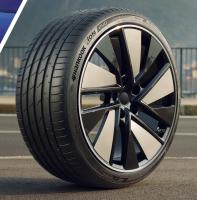
AutoBild evaluated models from premium manufacturers like Continental, Goodyear and Michelin alongside offerings from mid-range brands including Falken, Firestone and Yokohama, plus budget option Goodride. Interestingly, only two tyres in the test - the Hankook iON evo and Falken e.Ziex - were specifically designed as EV tyres, while others were standard tyres that manufacturers claim are also suitable for electric vehicles.
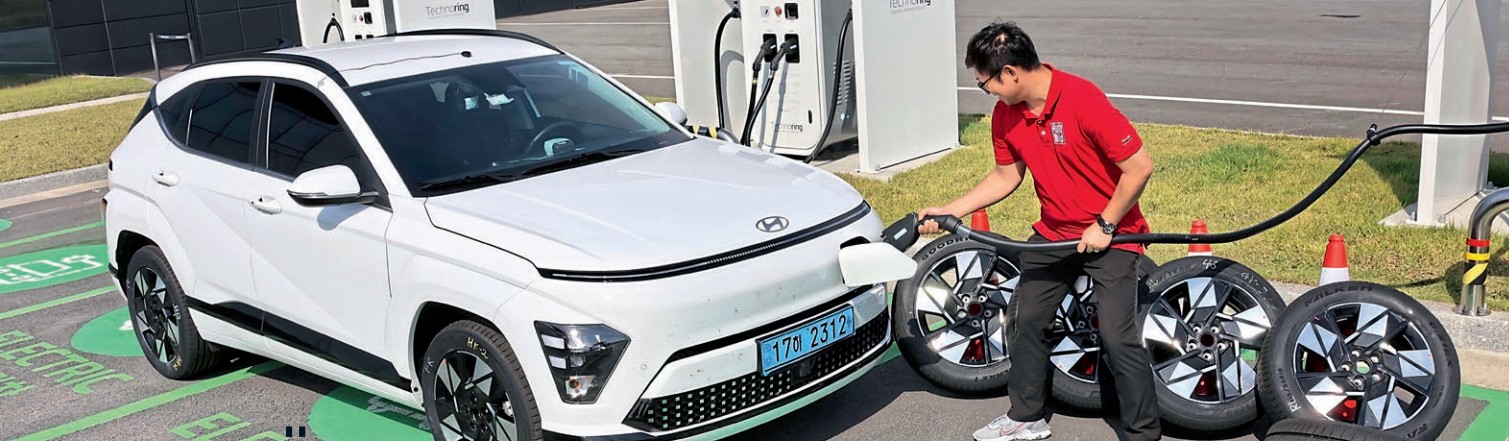
Testing was conducted on a Hyundai Kona EV, with tyres put through wet and dry handling, braking, and aquaplaning tests. Additionally, the publication measured rolling resistance and conducted a roll-out test to determine real-world range impact. The results showed that in extreme cases, tyre choice could affect vehicle range by up to 70 kilometers (43 miles.)
One of the most interesting findings was that the Hankook iON evo, specifically designed for EVs, claimed the overall victory, but standard tyres from Continental and Goodyear followed extremely closely behind. This suggests that the gap between dedicated EV tyres and high-quality standard tyres is minimal when balancing safety and efficiency needs.
Goodyear's EfficientGrip 2 SUV was awarded AutoBild's "Green Tyre 2025" environmental seal due to its excellent balance of rolling resistance, longevity, and environmental characteristics.
Dry
Hankook iON evo achieved the shortest braking distance of 33.6 meters, with Continental close behind at 34.5 meters. Goodride Solmax 1 needed significantly more distance at 37.8 meters, showing the safety gap between premium and budget options.
Dry Braking
Spread: 4.20 M (12.5%)|Avg: 35.73 M
Dry braking in meters (Lower is better)
Hankook iON Evo
33.60 M
Continental PremiumContact 7
34.50 M
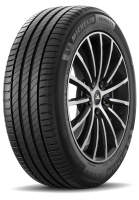
Michelin Primacy 4 Plus
35.10 M
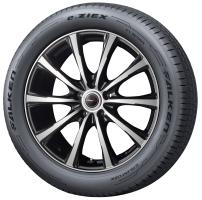
Falken e.Ziex
35.70 M
Goodyear EfficientGrip 2 SUV
35.90 M
Yokohama BluEarth XT AE61
36.60 M
Firestone Roadhawk 2 ENLITEN
36.60 M
Goodride Solmax 1
37.80 M
Hankook topped the handling test with 92.8 km/h average speed, followed by Continental at 91.9 km/h and Goodyear at 91.1 km/h. The Goodride again finished last with 88.2 km/h, confirming its limited cornering abilities.
Dry Handling
Spread: 4.60 Km/H (5%)|Avg: 90.74 Km/H
Dry Handling Average Speed (Higher is better)
Hankook iON Evo
92.80 Km/H
Continental PremiumContact 7
91.90 Km/H
Goodyear EfficientGrip 2 SUV
91.10 Km/H
Michelin Primacy 4 Plus
90.80 Km/H
Yokohama BluEarth XT AE61
90.50 Km/H
Firestone Roadhawk 2 ENLITEN
90.40 Km/H
Falken e.Ziex
90.20 Km/H
Goodride Solmax 1
88.20 Km/H
Wet
Continental took the lead in wet conditions with a 39.4-meter stopping distance, just ahead of Hankook at 39.6 meters. The gap to last-place Goodride widened to 48.7 meters, a 23% increase that could be critical in emergency situations.
Wet Braking
Spread: 9.30 M (23.6%)|Avg: 43.18 M
Wet braking in meters (100 - 0 km/h) (Lower is better)
Continental PremiumContact 7
39.40 M
Hankook iON Evo
39.60 M
Firestone Roadhawk 2 ENLITEN
41.80 M
Goodyear EfficientGrip 2 SUV
42.20 M
Michelin Primacy 4 Plus
43.20 M
Yokohama BluEarth XT AE61
44.90 M
Falken e.Ziex
45.60 M
Goodride Solmax 1
48.70 M
Hankook led wet handling with 74.4 km/h, narrowly beating Continental's 74.1 km/h. Goodyear maintained third position while Falken e.Ziex fell to second-last despite its EV-specific design.
Wet Handling
Spread: 6.00 Km/H (8.1%)|Avg: 71.65 Km/H
Wet Handling Average Speed (Higher is better)
Hankook iON Evo
74.40 Km/H
Continental PremiumContact 7
74.10 Km/H
Goodyear EfficientGrip 2 SUV
72.90 Km/H
Firestone Roadhawk 2 ENLITEN
72.00 Km/H
Yokohama BluEarth XT AE61
71.50 Km/H
Michelin Primacy 4 Plus
70.60 Km/H
Falken e.Ziex
69.30 Km/H
Goodride Solmax 1
68.40 Km/H
In the wet circle test, Hankook continued strong with 12.45 seconds, followed by Continental and Yokohama. Goodride again struggled with the slowest time at 13.03 seconds.
Wet Circle
Spread: 0.58 s (4.7%)|Avg: 12.72 s
Wet Circle Lap Time in seconds (Lower is better)
Hankook iON Evo
12.45 s
Continental PremiumContact 7
12.59 s
Yokohama BluEarth XT AE61
12.67 s
Falken e.Ziex
12.68 s
Firestone Roadhawk 2 ENLITEN
12.70 s
Goodyear EfficientGrip 2 SUV
12.79 s
Michelin Primacy 4 Plus
12.86 s
Goodride Solmax 1
13.03 s
Firestone Roadhawk 2 resisted aquaplaning up to 80.1 km/h, significantly better than its performance in other tests. Hankook placed second at 74.8 km/h, while Yokohama lost grip earliest at 63.7 km/h.
Straight Aqua
Spread: 16.40 Km/H (20.5%)|Avg: 70.66 Km/H
Float Speed in Km/H (Higher is better)
Firestone Roadhawk 2 ENLITEN
80.10 Km/H
Hankook iON Evo
74.80 Km/H
Falken e.Ziex
72.60 Km/H
Goodyear EfficientGrip 2 SUV
71.50 Km/H
Continental PremiumContact 7
69.30 Km/H
Goodride Solmax 1
67.50 Km/H
Michelin Primacy 4 Plus
65.80 Km/H
Yokohama BluEarth XT AE61
63.70 Km/H
Firestone maintained its aquaplaning advantage in curves with 3.02 m/s² lateral acceleration. Hankook again followed in second place, while Yokohama continued to struggle with water evacuation.
Curved Aquaplaning
Spread: 0.44 m/sec2 (14.6%)|Avg: 2.81 m/sec2
Remaining lateral acceleration (Higher is better)
Firestone Roadhawk 2 ENLITEN
3.02 m/sec2
Hankook iON Evo
2.97 m/sec2
Goodride Solmax 1
2.85 m/sec2
Goodyear EfficientGrip 2 SUV
2.84 m/sec2
Falken e.Ziex
2.84 m/sec2
Continental PremiumContact 7
2.74 m/sec2
Michelin Primacy 4 Plus
2.60 m/sec2
Yokohama BluEarth XT AE61
2.58 m/sec2
Comfort
Yokohama produced the least external noise at 68.7 dB, a key advantage for quiet EV operation. Continental and Firestone were the loudest at over 72 dB, showing their focus on grip over comfort.
Noise
Spread: 3.40 dB (4.9%)|Avg: 70.66 dB
External noise in dB (Lower is better)
Yokohama BluEarth XT AE61
68.70 dB
Goodyear EfficientGrip 2 SUV
69.90 dB
Hankook iON Evo
70.20 dB
Goodride Solmax 1
70.30 dB
Falken e.Ziex
70.90 dB
Michelin Primacy 4 Plus
71.20 dB
Firestone Roadhawk 2 ENLITEN
72.00 dB
Continental PremiumContact 7
72.10 dB
Goodyear EfficientGrip 2 SUV leads in subjective comfort with 8 points, highlighting its balanced approach to both efficiency and ride quality. Most premium contenders like Hankook, Continental, Michelin and Falken offer respectable comfort with 7 points. The budget Goodride Solmax 1 trails significantly with just 5 points, showing where cost-cutting affects the driving experience most noticeably.
Subj. Comfort
Spread: 3.00 Points (37.5%)|Avg: 6.75 Points
Subjective Comfort Score (Higher is better)
Goodyear EfficientGrip 2 SUV
8.00 Points
Michelin Primacy 4 Plus
7.00 Points
Continental PremiumContact 7
7.00 Points
Falken e.Ziex
7.00 Points
Hankook iON Evo
7.00 Points
Firestone Roadhawk 2 ENLITEN
7.00 Points
Yokohama BluEarth XT AE61
6.00 Points
Goodride Solmax 1
5.00 Points
Value
Goodyear showed the best durability with a projected 49,050 km lifespan. Michelin placed second at 44,920 km, while Firestone's 28,510 km was just over half of Goodyear's life expectancy.
Wear
Spread: 20540.00 KM (41.9%)|Avg: 38073.75 KM
Predicted tread life in KM (Higher is better)
Goodyear EfficientGrip 2 SUV
49050.00 KM
Michelin Primacy 4 Plus
44920.00 KM
Hankook iON Evo
43120.00 KM
Continental PremiumContact 7
40890.00 KM
Falken e.Ziex
36790.00 KM
Goodride Solmax 1
31030.00 KM
Yokohama BluEarth XT AE61
30280.00 KM
Firestone Roadhawk 2 ENLITEN
28510.00 KM
Budget Goodride offered the best cost efficiency at €11 per 1,000 km despite performance limitations. Goodyear combined durability with competitive pricing for second place, while premium-priced Michelin ranked last at €16.4 per 1,000 km.
Falken e.Ziex recorded the lowest rolling resistance at 5.86 kg/t, followed by Michelin and Hankook. Continental had the highest at 7.66 kg/t, showing its priority on grip over efficiency.
Rolling Resistance
Spread: 1.80 kg / t (30.7%)|Avg: 7.02 kg / t
Rolling resistance in kg t (Lower is better)
Falken e.Ziex
5.86 kg / t
Michelin Primacy 4 Plus
6.51 kg / t
Hankook iON Evo
6.81 kg / t
Goodyear EfficientGrip 2 SUV
7.15 kg / t
Goodride Solmax 1
7.22 kg / t
Firestone Roadhawk 2 ENLITEN
7.33 kg / t
Yokohama BluEarth XT AE61
7.58 kg / t
Continental PremiumContact 7
7.66 kg / t
19,000 km
£1.45/L
8.0 L/100km
--
Annual Difference
--
Lifetime Savings
--
Extra Fuel/Energy
--
Extra CO2
Estimates based on typical driving conditions. Rolling resistance accounts for approximately 20% of IC vehicle fuel consumption and 25% of EV energy consumption. Actual savings vary based on driving style, vehicle weight, road conditions, and tyre age. For comparative purposes only. Lifetime savings based on a 40,000km / 25,000 mile tread life.
Falken's efficiency translated to 410 km range, 65.6 km more than Continental's 344.4 km. Hankook balanced performance with efficiency for second place at 381.3 km, highlighting how tyre choice affects EV range.
The Hankook iON evo, specifically designed for electric vehicles, achieved first place with outstanding wet and dry performance. It delivered excellent braking distances (39.6m in wet, 33.6m in dry), strong handling characteristics, and good aquaplaning resistance. With a projected lifespan of 43,120km and moderate rolling resistance (6.81 kg/t), it provides a good balance between safety and efficiency. The tyre offered 381.3km of range in the EV test and strong cornering grip, securing an overall "exemplary" rating.
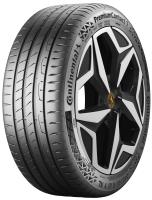
Continental's PremiumContact 7 delivered the shortest wet braking distance (39.4m) and strong dry performance. Despite having the highest rolling resistance in the test (7.66 kg/t) and lowest range impact (344.4km), its safety credentials remained impressive with sharp handling characteristics and a projected lifespan of 40,890km. This tyre secured second place with minimal difference from the winner, proving standard tyres can perform effectively on EVs.
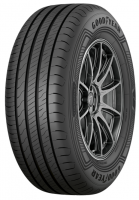
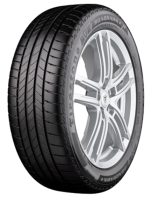
The Goodyear EfficientGrip 2 SUV achieved third place and won the "Green Tyre" award for its environmental credentials. Its standout feature was exceptional longevity with a projected 49,050km lifespan - the highest in the test. The tyre offered balanced wet (42.2m braking) and dry performance with moderate rolling resistance (7.15 kg/t). Its range impact was 373.1km, placing it mid-field, but its overall combination of efficiency and safety secured its position as the most environmentally friendly option.
The Michelin Primacy 4+ delivered good all-round performance with short braking distances (43.2m wet, 35.1m dry) and solid handling. It showed low rolling resistance (6.51 kg/t) and delivered 377.2km of range in the test. As the most expensive tyre (€735), it offered strong longevity (44,920km) but suffered from limited aquaplaning resistance, especially in curved conditions. While not explicitly marketed as an EV tyre, it performed well in efficiency metrics.
The Falken e.Ziex, specifically designed for EVs, stood out for having the lowest rolling resistance (5.86 kg/t) and provided the best range result (410km). It demonstrated good aquaplaning resistance but showed longer wet braking distances (45.6m) compared to top performers. With average dry handling and a moderate projected lifespan of 36,790km, it secured a "good" overall rating with clear focus on efficiency over ultimate grip.
The Firestone Roadhawk 2 excelled in aquaplaning resistance, achieving the best performance in both straight-line (80.1 km/h) and curved aquaplaning tests (3.02 m/s²). However, it showed limitations in wet braking (41.8m) and overall grip. With a modest projected lifespan of 28,510km (the lowest in the test) and mid-range rolling resistance (7.33 kg/t), the tyre's range impact was below average at 352.6km. Its performance earned a "satisfactory" rating.
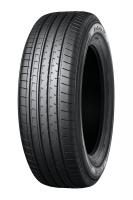
The Yokohama BluEarth-XT recorded the quietest passing noise in the test (68.7 dB at 80 km/h), making it ideal for silent EVs. Its dry performance was reasonable, but wet weather capabilities showed weaknesses, particularly in aquaplaning resistance where it recorded the lowest values. With a projected lifespan of 30,280km and high rolling resistance (7.58 kg/t), its range impact was 373.1km. The tyre received a "satisfactory" rating for its mixed performance profile.
As the budget option, the Goodride Solmax 1 showed significant compromises in safety. It recorded the longest wet braking distance (48.7m) and limited handling capabilities. Its projected lifespan was 31,030km with moderate rolling resistance (7.22 kg/t), providing a range of 373.2km. Despite its affordable price (€340), its safety limitations resulted in a "conditionally recommended" rating, placing it last in the test.
These are great tests and the results are very helpful. However, I have a 2020 Tesla Model Y that have 255/40R20 so it's harder or impossible to find in your test fleet. In my location of Minneapolis it's VERY common to have dedicated snows (mine are Sottozero 3) and a good All Season for the rest of the year. It turns out finding a good 3+ seasons tire in my size is not easy. I must walk thru a whole series of trade-offs to get a few remaining features I can live with. I can find a summer tire with does well dry & wet & handling & braking. But replacing that soft rubber every 25K miles? I managed nearly 30K miles out of the original Eagle F1 that came with my Model Y (they've changed that now) only because I have experience driving a 4200 pound over-powered car before. It's not the weight its the heavy foot. Taking the highway cloverleaf ramp at 55 mph when it's 90 degrees F means you rub off 1000 hwy miles in 15 seconds. Anyway, some tire testing with my tire size requirements would be immensely helpful. You do great testing! Thank you for that work.
This is a great question! From what I understand, the impact of tires on range is much smaller at highway speeds. So if this test was run at highway speeds, you might see as much as 2x this impact at slower speeds, versus if this test was done at lower speeds, the impact could be as little as 1/2 of this at highway speeds
Shouldn´t the range scale be the other way around? I believe the Falken should have a 100% grade and be the 1st and the Continental 84%, being the 8th.




These are great tests and the results are very helpful. However, I have a 2020 Tesla Model Y that have 255/40R20 so it's harder or impossible to find in your test fleet. In my location of Minneapolis it's VERY common to have dedicated snows (mine are Sottozero 3) and a good All Season for the rest of the year. It turns out finding a good 3+ seasons tire in my size is not easy. I must walk thru a whole series of trade-offs to get a few remaining features I can live with. I can find a summer tire with does well dry & wet & handling & braking. But replacing that soft rubber every 25K miles? I managed nearly 30K miles out of the original Eagle F1 that came with my Model Y (they've changed that now) only because I have experience driving a 4200 pound over-powered car before. It's not the weight its the heavy foot. Taking the highway cloverleaf ramp at 55 mph when it's 90 degrees F means you rub off 1000 hwy miles in 15 seconds. Anyway, some tire testing with my tire size requirements would be immensely helpful. You do great testing! Thank you for that work.
I am in Canada and Hankook has the winter version of the iON. It's called the ION icept
That's a lot of difference a tire can make on the range! Is there any data on this publication at what sort of speed range tests were performed?
I didn't see that data, sorry.
This is a great question! From what I understand, the impact of tires on range is much smaller at highway speeds. So if this test was run at highway speeds, you might see as much as 2x this impact at slower speeds, versus if this test was done at lower speeds, the impact could be as little as 1/2 of this at highway speeds
I believe Autobild usually run the tyres on an oval around 80kmh but I would need to check.
A tyres impact remains relatively constant but you are correct that the aero factor squares so at higher speeds the air is a bigger issue.
Shouldn´t the range scale be the other way around? I believe the Falken should have a 100% grade and be the 1st and the Continental 84%, being the 8th.
Which chart are you referring to?
The last one
Yes you are correct, nice spot. Let me fix that.