All season VS winter tires is a hotly discussed topic, and while we've done our own test at various temperatures, it sadly didn't include any ice testing, or things like wet handling and rolling resistance testing.
Fortunately, our friends at Vi Bilagare once again have us covered. During their Nordic winter testing in 2020, the magazine included an all season and "european" winter tire alongside their usual selection of Nordic friction and studded winter tires.
As the all-season and European winter tire were being tested from a Nordic perspective, they had a significant testing on ice, which is a rarity for an all-season tire.
The results... well, I’m sure you can guess how each of the four tire types performed on each surface, but it's really cool to see all this data from one source.
One last thing worth noting, while the all-season and winter tires are named tires, the Nordic winter tire and studded winter tire are an average of the five best tires for each category from their respective full tests, not a single tire pattern we can name.
Ice
Ice is the most extreme surface for winter tires, so it's no surprise that during the ice braking and traction testing on smooth ice, the studded tire held the advantage.
The Nordic winter tire was impressively close to the studded tire during ice braking, stopping the car just 1.1 meters further on, with a larger 3.5 meter gap back to the European winter tire. The all-season tire also had an impressive result considering it's not developed for harsh winters, stopping less than 1 meter longer than the European winter tire.
Ice Braking
Spread: 5.19 M (52.4%)|Avg: 12.55 M
Ice braking in meters (25 - 5 km/h) (Lower is better)
Ice Braking: Safety Impact: Best vs Worst Tyre
The order of the tires remained the same for the traction test.
Ice Traction
Spread: 3.61 s (79.3%)|Avg: 6.58 s
Ice acceleration time (5 - 25 km/h) (Lower is better)
Reference Winter Studded
4.55 s
Reference Winter Nordic
6.00 s
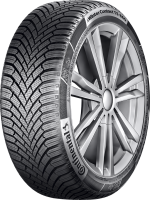
Continental WinterContact TS 860
7.61 s
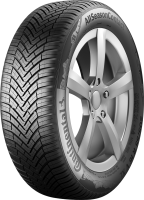
Continental AllSeasonContact
8.16 s
Ice handling was a real surprise, with the Nordic winter tire actually besting the studded tire! This is down to the ice handling testing taking part on rough, not smooth ice, where the softer compound of a Nordic winter tire is better at adapting to the rough surface, and the steering response better than a studded tire.
Ice Handling
Spread: 6.72 s (12.5%)|Avg: 56.77 s
Ice handling time in seconds (Lower is better)
Reference Winter Nordic
53.85 s
Reference Winter Studded
54.18 s
Continental WinterContact TS 860
58.49 s
Continental AllSeasonContact
60.57 s
Snow
Snow testing showed a similar pattern to ice, just with slightly bigger gaps between the different types of tires.
The Nordic and studded winter tires were very close during the snow braking testing, with the all season tire falling further behind the European winter tire than during the ice testing.
Snow Braking
Spread: 3.24 M (18.5%)|Avg: 18.75 M
Snow braking in meters (40 - 5 km/h) (Lower is better)
Snow Braking: Safety Impact: Best vs Worst Tyre
This pattern was again replicated during snow traction testing, but this time the studded winter tire had a slight advantage over the Nordic winter tire.
Snow Traction
Spread: 0.58 s (13.8%)|Avg: 4.44 s
Snow acceleration time (5 - 40 km/h) (Lower is better)
Reference Winter Studded
4.19 s
Reference Winter Nordic
4.23 s
Continental WinterContact TS 860
4.55 s
Continental AllSeasonContact
4.77 s
Snow handling had the all-season tire fall significantly behind the european winter tire.
Snow Handling
Spread: 12.12 s (14%)|Avg: 90.98 s
Snow handling time in seconds (Lower is better)
Reference Winter Studded
86.76 s
Reference Winter Nordic
87.47 s
Continental WinterContact TS 860
90.81 s
Continental AllSeasonContact
98.88 s
Wet
While the all season tire struggled in snow and ice, the results were reversed during wet testing.
Like in previous testing, there was larger gap between the more extreme winter tires and the European winter tire, than the European winter tire and the all-season tire, with the Continental AllSeasonContact and WinterContact TS860 performing vastly better during wet braking.
Wet Braking
Spread: 5.68 M (21.9%)|Avg: 28.54 M
Wet braking in meters (80 - 0 km/h) (Lower is better)
Continental AllSeasonContact
25.90 M
Continental WinterContact TS 860
26.60 M
Reference Winter Studded
30.06 M
Reference Winter Nordic
31.58 M
This trend continued to wet handling.
Wet Handling
Spread: 4.77 s (12%)|Avg: 42.03 s
Wet handling time in seconds (Lower is better)
Continental AllSeasonContact
39.63 s
Continental WinterContact TS 860
40.45 s
Reference Winter Studded
43.65 s
Reference Winter Nordic
44.40 s
Aquaplaning was also very close between the two milder climate tires, with the snow and ice specialists struggling to clear standing water.
Straight Aqua
Spread: 14.90 Km/H (19.9%)|Avg: 67.88 Km/H
Float Speed in Km/H (Higher is better)
Continental WinterContact TS 860
74.90 Km/H
Continental AllSeasonContact
74.60 Km/H
Reference Winter Nordic
62.00 Km/H
Reference Winter Studded
60.00 Km/H
Dry
As in the wet, the more extreme the tire, the more it struggled in the dry, with a large gap between the all-season and studded tires during the dry braking testing.
Dry Braking
Spread: 6.44 M (16.1%)|Avg: 43.41 M
Dry braking in meters (100 - 0 km/h) (Lower is better)
Continental AllSeasonContact
40.10 M
Continental WinterContact TS 860
41.90 M
Reference Winter Nordic
45.10 M
Reference Winter Studded
46.54 M
Environment
The gaps in rolling resistance weren’t huge, which was impressive for a studded tire.
Rolling Resistance
Spread: 0.19 kg / t (4.3%)|Avg: 4.56 kg / t
Rolling resistance in kg t (Lower is better)
Reference Winter Nordic
4.47 kg / t
Reference Winter Studded
4.54 kg / t
Continental AllSeasonContact
4.56 kg / t
Continental WinterContact TS 860
4.66 kg / t
19,000 km
£1.45/L
8.0 L/100km
--
Annual Difference
--
Lifetime Savings
--
Extra Fuel/Energy
--
Extra CO2
Estimates based on typical driving conditions. Rolling resistance accounts for approximately 20% of IC vehicle fuel consumption and 25% of EV energy consumption. Actual savings vary based on driving style, vehicle weight, road conditions, and tyre age. For comparative purposes only. Lifetime savings based on a 40,000km / 25,000 mile tread life.
Naturally, the studded tire was significantly nosier than any of the other tires, with the softer compound of the Nordic winter tire producing the lowest noise.
I live in South West Norway, where winter is mostly wet asphalt, but with periods of everything from snow, through slush to thick, uneven, wet ice. Up to now I have driven on nordic winter tyres, but will soon be switching to quite a heavy EV. I have read that nordic rubber doesn't suit EVs well and was wondering if the extra weight might warrant using a good European tyre, like the winter contact TS870p, which has better drainage and might be better in the wet conditions that we get the most. The standard winter tyres for the car in Norway are Viking contact 7.
I know a lot of the US guys really rate the X-Ice Snow on the Teslas, which I realise is a nordic winter tyre but it seems less extreme than some.
If the Viking Contact 7 is an OE tyre for the vehicle it will have been developed with the weight and torque in mind so that would likely be the best option.
Thanks for that. After reading your reply and checking out the local company that deals with tyres for Polestar, I went with the X-Ice Snow. Not the best in the wet, but one of the better nordics and a good all-rounder.
It's pretty cool to see how different types of winter tyres act and compare to each other. I've long wanted to test different "blends" myself but, well, real life and budgets and stuff like that. However... I live in a nordic country and we have mandatory winter tyres that have to have M+S and 3PMSF ratings on them from December 1st until last day of February. You can legally run your summer tyres from March 1st but that I would consider as chasing the Darwin's award. I have used different winter tyres over the 12 years I've owned cars. I've used expensive studs, very very cheap chinese brands, mid-range winter tyres, very expensive top of the line nordic un-studded tyres and I once did try chasing the Darwin's award by replacing winters with summers on 1st of March. I survived. It was a poor winter tho, no snow, no ice, just cold and dry roads. But I have not tested a proper good quality all-season tyre during winter. Now, I've looked at most of the tyre tests and yes, nordic and studded "blends" are awesome on snow and ice. You really can't beat a set of Nokians or Contis doing their business on snow and ice. But, as I am a city dweller who quite occasionally takes a drive out of town, mostly on major roads, 90% of my driving time is spent on wet roads since we use a stupendous amount of salt on our roads. The temperature is mostly a few degrees below freezing and we get an occasional snow-storm or overnight fresh powder but there's hardly ever any ice on the roads. It's a bit different when navigating through supermarket parking lots, it seems that nobody tends to those, and small city streets in residential areas might have a lof of loose or packed snow as it's really difficult to clean those areas up with cars that are parked everywhere. But the speeds are low and the chance to slip and crash are non-existent unless you drive like an idiot. So here I am, wondering away, if I should take a plunge and try a decent set of all-seasons next time I replace winter tyres. Or not.
It's an interesting dilemma, but I'm not sure you'll find a tester / tyre company in the world that would recommend an all season tyre as a winter for nordic climates, as ice is the downfall.
It's worth remembering that these Conti all season tyres are a fairly winter bias set, and a tyre like the CrossClimate or A005 would be even further back on ice.
Back again to regret and repent my stupid ideas. The thing that got me thinking about using all-seasons was that we haven't had a proper winter in years now. Well, proper winter happened. It's mayhem. There's so much snow. And ice. And it's fun. Unless you have to dig out your car every morning from the snow. Yes, Nordic blends all the way. I pity the fools with no proper rubber and am ashamed of my heretical thinking. I hope the Spanish Inquisition won't catch me.
There is one gap in recomment - You haven't bought nor tested and all-season tire. So that's a shame because I thought that would be respectfull information. Nonetheless good for you that you have proper tires anyway. : )
Yes you have! Thank you for that, at last I can compare results of test made in the same environment and conditions. My comments was about Mike's heretical thinking. :) I am very close to buy an all-season tire (vector gen-3) as winter tires for my S-max 2.2 200hp but there is still a bit of concern if that will be fine with occasional snow in Poland where i live. I have used an all-seasons before as allyear tire (Quadraxer 2 and Nokian weatherproof) on my Skoda Rapid and Renault Megane 3 but an S-max is way heavier and powerfull. On one hand all-seasons seems to be better at everything except snow vs winter tires but on the other the difference is not that big. But on the snow the difference is theoretically not that big either but in the real life amount of snow might be way bigger that on the video with test. Tests will be tests, I guess everyone have to make his own choice. :) I do enjoy watching your videos TyreReviews, as an engineer I appreciate methodology and precision with a bit of entertainment. Cheers!
I think if it's just snow, I'll be fine with all season as winter. However if you start to see any serious ice or compacted snow, that's when the winter tyre stretches its legs :)




I live in South West Norway, where winter is mostly wet asphalt, but with periods of everything from snow, through slush to thick, uneven, wet ice. Up to now I have driven on nordic winter tyres, but will soon be switching to quite a heavy EV. I have read that nordic rubber doesn't suit EVs well and was wondering if the extra weight might warrant using a good European tyre, like the winter contact TS870p, which has better drainage and might be better in the wet conditions that we get the most. The standard winter tyres for the car in Norway are Viking contact 7.
I know a lot of the US guys really rate the X-Ice Snow on the Teslas, which I realise is a nordic winter tyre but it seems less extreme than some.
If the Viking Contact 7 is an OE tyre for the vehicle it will have been developed with the weight and torque in mind so that would likely be the best option.
Thanks for that. After reading your reply and checking out the local company that deals with tyres for Polestar, I went with the X-Ice Snow. Not the best in the wet, but one of the better nordics and a good all-rounder.
It's pretty cool to see how different types of winter tyres act and compare to each other. I've long wanted to test different "blends" myself but, well, real life and budgets and stuff like that. However...
I live in a nordic country and we have mandatory winter tyres that have to have M+S and 3PMSF ratings on them from December 1st until last day of February. You can legally run your summer tyres from March 1st but that I would consider as chasing the Darwin's award.
I have used different winter tyres over the 12 years I've owned cars. I've used expensive studs, very very cheap chinese brands, mid-range winter tyres, very expensive top of the line nordic un-studded tyres and I once did try chasing the Darwin's award by replacing winters with summers on 1st of March. I survived. It was a poor winter tho, no snow, no ice, just cold and dry roads. But I have not tested a proper good quality all-season tyre during winter.
Now, I've looked at most of the tyre tests and yes, nordic and studded "blends" are awesome on snow and ice. You really can't beat a set of Nokians or Contis doing their business on snow and ice. But, as I am a city dweller who quite occasionally takes a drive out of town, mostly on major roads, 90% of my driving time is spent on wet roads since we use a stupendous amount of salt on our roads. The temperature is mostly a few degrees below freezing and we get an occasional snow-storm or overnight fresh powder but there's hardly ever any ice on the roads. It's a bit different when navigating through supermarket parking lots, it seems that nobody tends to those, and small city streets in residential areas might have a lof of loose or packed snow as it's really difficult to clean those areas up with cars that are parked everywhere. But the speeds are low and the chance to slip and crash are non-existent unless you drive like an idiot.
So here I am, wondering away, if I should take a plunge and try a decent set of all-seasons next time I replace winter tyres. Or not.
It's an interesting dilemma, but I'm not sure you'll find a tester / tyre company in the world that would recommend an all season tyre as a winter for nordic climates, as ice is the downfall.
It's worth remembering that these Conti all season tyres are a fairly winter bias set, and a tyre like the CrossClimate or A005 would be even further back on ice.
Back again to regret and repent my stupid ideas.
The thing that got me thinking about using all-seasons was that we haven't had a proper winter in years now. Well, proper winter happened. It's mayhem. There's so much snow. And ice. And it's fun. Unless you have to dig out your car every morning from the snow.
Yes, Nordic blends all the way. I pity the fools with no proper rubber and am ashamed of my heretical thinking. I hope the Spanish Inquisition won't catch me.
Glad you came to that conclusion before purchasing any tyres :)
There is one gap in recomment - You haven't bought nor tested and all-season tire. So that's a shame because I thought that would be respectfull information. Nonetheless good for you that you have proper tires anyway. : )
We done it, there's a full video on youtube
Yes you have! Thank you for that, at last I can compare results of test made in the same environment and conditions. My comments was about Mike's heretical thinking. :)
I am very close to buy an all-season tire (vector gen-3) as winter tires for my S-max 2.2 200hp but there is still a bit of concern if that will be fine with occasional snow in Poland where i live. I have used an all-seasons before as allyear tire (Quadraxer 2 and Nokian weatherproof) on my Skoda Rapid and Renault Megane 3 but an S-max is way heavier and powerfull.
On one hand all-seasons seems to be better at everything except snow vs winter tires but on the other the difference is not that big. But on the snow the difference is theoretically not that big either but in the real life amount of snow might be way bigger that on the video with test.
Tests will be tests, I guess everyone have to make his own choice. :)
I do enjoy watching your videos TyreReviews, as an engineer I appreciate methodology and precision with a bit of entertainment.
Cheers!
I think if it's just snow, I'll be fine with all season as winter. However if you start to see any serious ice or compacted snow, that's when the winter tyre stretches its legs :)