The 2024 summer tyre test conducted by Sport Auto magazine compared five premium-category summer tyres against an all-season tyre on a Hyundai i20 N. The test aimed to determine if the all-season tyre could compete with the best summer tyres had to offer during warm (approximately 25c / 77f air temperature) conditions.
Including an all-season tyre in a summer tyre test, which is something we will be doing towards the end of 2024, provides an interesting insight into the performance differences between dedicated summer tyres and all-season options. It highlights the performance gap between summer and all-season tyres under conditions where summer tyres are expected to excel. This can help consumers understand the trade-offs involved in opting for an all-season tyre, particularly in terms of grip, braking, and handling on both wet and dry surfaces.
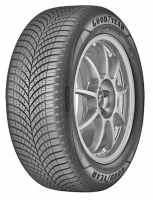
The all season tyre chosen was the Goodyear Vector 4-Season Gen-3, which has won many all season tyres tests, including the 2023 Tyre Reviews all season tyre test. However, when compared to the summer tyres in the Sport Auto test, showed that it could not match the performance of summer-specific tyres, particularly in wet conditions and handling aspects.
Wet Performance: The all-season tyre had significantly longer braking distances in the wet compared to the best-performing summer tyres. This indicates a clear disadvantage in wet grip, which is a critical safety aspect in rainy conditions.
Dry Performance: While the all-season tyre may have offered adequate performance on dry roads, it still fell short of the summer tyres' capabilities, particularly in terms of handling and braking distances. Summer tyres exhibited better grip, shorter braking distances, and more dynamic handling on dry asphalt.
Aquaplaning Resistance: The all-season tyre showed weaker performance in aquaplaning resistance. The summer tyres, with their specialized tread patterns, were more effective at water displacement, reducing the risk of aquaplaning on wet roads.
Handling and Stability: In dynamic handling tests, the all-season tyre was found to be less responsive and offered less stability compared to summer tyres. The summer tyres demonstrated superior lateral support and more precise steering on both wet and dry tracks.
While the Goodyear Vector 4Seasons Gen-3 all-season tyre provided a versatile option suitable for varied conditions, it did not perform on par with summer tyres in the test, especially in critical areas like wet grip and handling. This performance gap underscores the trade-offs of using all-season tyres in conditions where summer tyres are optimized to excel.
Finally, it's worth noting that the Bridgestone Turanza T005 was the AO marked (Audi original) tyre, which will have been optimised for the Audi A1. We're not quite sure why this was in a test on a Hyundai, as a rule we do not test OE tyres.
Data
Michelin and Continental led the group, stopping the vehicle in 35.5 meters from 100km/h. The worst summer tyre, the Dunlop, took 37.1 meters and the all season tyre took 43.2 meters. The Goodyear has never been the best all season tyre in dry braking, but that's a significant gap.
Dry Braking
Spread: 7.70 M (21.7%)|Avg: 37.27 M
Dry braking in meters (100 - 0 km/h) (Lower is better)
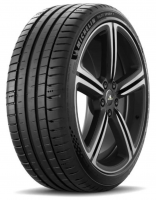
Michelin Pilot Sport 5
35.50 M
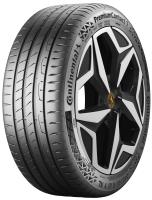
Continental PremiumContact 7
35.50 M
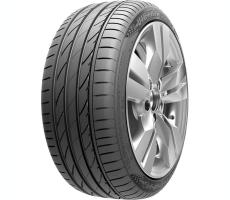
Maxxis Victra Sport 5
35.90 M
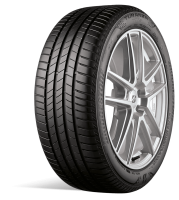
Bridgestone Turanza T005
36.40 M
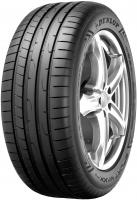
Dunlop SportMaxx RT 2
37.10 M
Goodyear Vector 4Seasons Gen 3
43.20 M
It was a similar story in dry handling with the Continental and Michelin leading the group, and the all season tyre slowest.
Dry Handling
Spread: 3.90 Km/H (3.7%)|Avg: 103.80 Km/H
Dry Handling Average Speed (Higher is better)
Continental PremiumContact 7
105.30 Km/H
Michelin Pilot Sport 5
105.10 Km/H
Maxxis Victra Sport 5
103.80 Km/H
Dunlop SportMaxx RT 2
103.70 Km/H
Bridgestone Turanza T005
103.50 Km/H
Goodyear Vector 4Seasons Gen 3
101.40 Km/H
Wet
Continental again led wet braking, this time with Bridgestone being the next best tyre.
Wet Braking
Spread: 5.80 M (19.5%)|Avg: 31.72 M
Wet braking in meters (80 - 0 km/h) (Lower is better)
Continental PremiumContact 7
29.80 M
Bridgestone Turanza T005
30.60 M
Michelin Pilot Sport 5
30.80 M
Maxxis Victra Sport 5
31.50 M
Dunlop SportMaxx RT 2
32.00 M
Goodyear Vector 4Seasons Gen 3
35.60 M
Continental was again best during the wet handling and wet circle tests.
Wet Handling
Spread: 3.60 Km/H (4.5%)|Avg: 78.78 Km/H
Wet Handling Average Speed (Higher is better)
Continental PremiumContact 7
80.20 Km/H
Michelin Pilot Sport 5
79.60 Km/H
Bridgestone Turanza T005
79.10 Km/H
Maxxis Victra Sport 5
79.10 Km/H
Dunlop SportMaxx RT 2
78.10 Km/H
Goodyear Vector 4Seasons Gen 3
76.60 Km/H
Wet Circle
Spread: 0.65 m/s (7.5%)|Avg: 8.57 m/s
Lateral wet grip in m/s squared (Higher is better)
Continental PremiumContact 7
8.72 m/s
Maxxis Victra Sport 5
8.71 m/s
Michelin Pilot Sport 5
8.71 m/s
Bridgestone Turanza T005
8.68 m/s
Dunlop SportMaxx RT 2
8.54 m/s
Goodyear Vector 4Seasons Gen 3
8.07 m/s
The all season tyre continued to struggle in the deeper water of aquaplaning.
Straight Aqua
Spread: 6.00 Km/H (7.8%)|Avg: 75.77 Km/H
Float Speed in Km/H (Higher is better)
Bridgestone Turanza T005
77.20 Km/H
Dunlop SportMaxx RT 2
76.80 Km/H
Michelin Pilot Sport 5
76.70 Km/H
Continental PremiumContact 7
76.40 Km/H
Maxxis Victra Sport 5
76.30 Km/H
Goodyear Vector 4Seasons Gen 3
71.20 Km/H
Curved Aquaplaning
Spread: 3.13 m/sec2 (37%)|Avg: 7.60 m/sec2
Remaining lateral acceleration (Higher is better)
Continental PremiumContact 7
8.45 m/sec2
Dunlop SportMaxx RT 2
8.15 m/sec2
Bridgestone Turanza T005
7.96 m/sec2
Maxxis Victra Sport 5
7.95 m/sec2
Michelin Pilot Sport 5
7.76 m/sec2
Goodyear Vector 4Seasons Gen 3
5.32 m/sec2
Comfort
The all season tyre did have the lowest pass by noise, it's only test win.
Noise
Spread: 1.20 dB (1.7%)|Avg: 71.63 dB
External noise in dB (Lower is better)
Goodyear Vector 4Seasons Gen 3
71.00 dB
Dunlop SportMaxx RT 2
71.40 dB
Maxxis Victra Sport 5
71.50 dB
Bridgestone Turanza T005
71.80 dB
Continental PremiumContact 7
71.90 dB
Michelin Pilot Sport 5
72.20 dB
Value
The Bridgestone Turanza T005 had the lowest rolling resistance, something the OE would tune the tyre towards.
Rolling Resistance
Spread: 1.40 kg / t (17.9%)|Avg: 8.35 kg / t
Rolling resistance in kg t (Lower is better)
Bridgestone Turanza T005
7.80 kg / t
Dunlop SportMaxx RT 2
7.90 kg / t
Michelin Pilot Sport 5
8.20 kg / t
Continental PremiumContact 7
8.20 kg / t
Goodyear Vector 4Seasons Gen 3
8.80 kg / t
Maxxis Victra Sport 5
9.20 kg / t
19,000 km
£1.45/L
8.0 L/100km
--
Annual Difference
--
Lifetime Savings
--
Extra Fuel/Energy
--
Extra CO2
Estimates based on typical driving conditions. Rolling resistance accounts for approximately 20% of IC vehicle fuel consumption and 25% of EV energy consumption. Actual savings vary based on driving style, vehicle weight, road conditions, and tyre age. For comparative purposes only. Lifetime savings based on a 40,000km / 25,000 mile tread life.
Extremely controllable in wet conditions, great steering precision, high protection against aquaplaning. Agile on dry surfaces, stable in tracking, very safe.
Minor comfort compromises with the rear axle.
Very grippy on wet and dry roads, very balanced and safe to drive.
Excellent controllability thanks to very high grip level on wet and dry tracks, shortest dry braking distances. Rolling resistance and pass-by noise are low.
Moderate aquaplaning protection in curves, partially somewhat bouncy ride.
Balanced and very safe to drive on both wet and dry roads.
The Turanza T005 AO, optimised for the Audi A1, is grippy on dry roads and when it rains. It has low rolling resistance, good rolling comfort, and high protection against longitudinal aquaplaning.
The rear axle is more susceptible to load changes at the limit.
Generally grippy and easy-rolling. Could be more balanced.
High lateral support in wet conditions, spontaneous steering response, precise in switchback curves. Dynamic dry handling with high lane change safety.
Fairly long braking distances in the wet, somewhat delayed steering response in dry conditions, high rolling resistance.
Dynamic handling, but long braking distances in the wet.




Discussion